
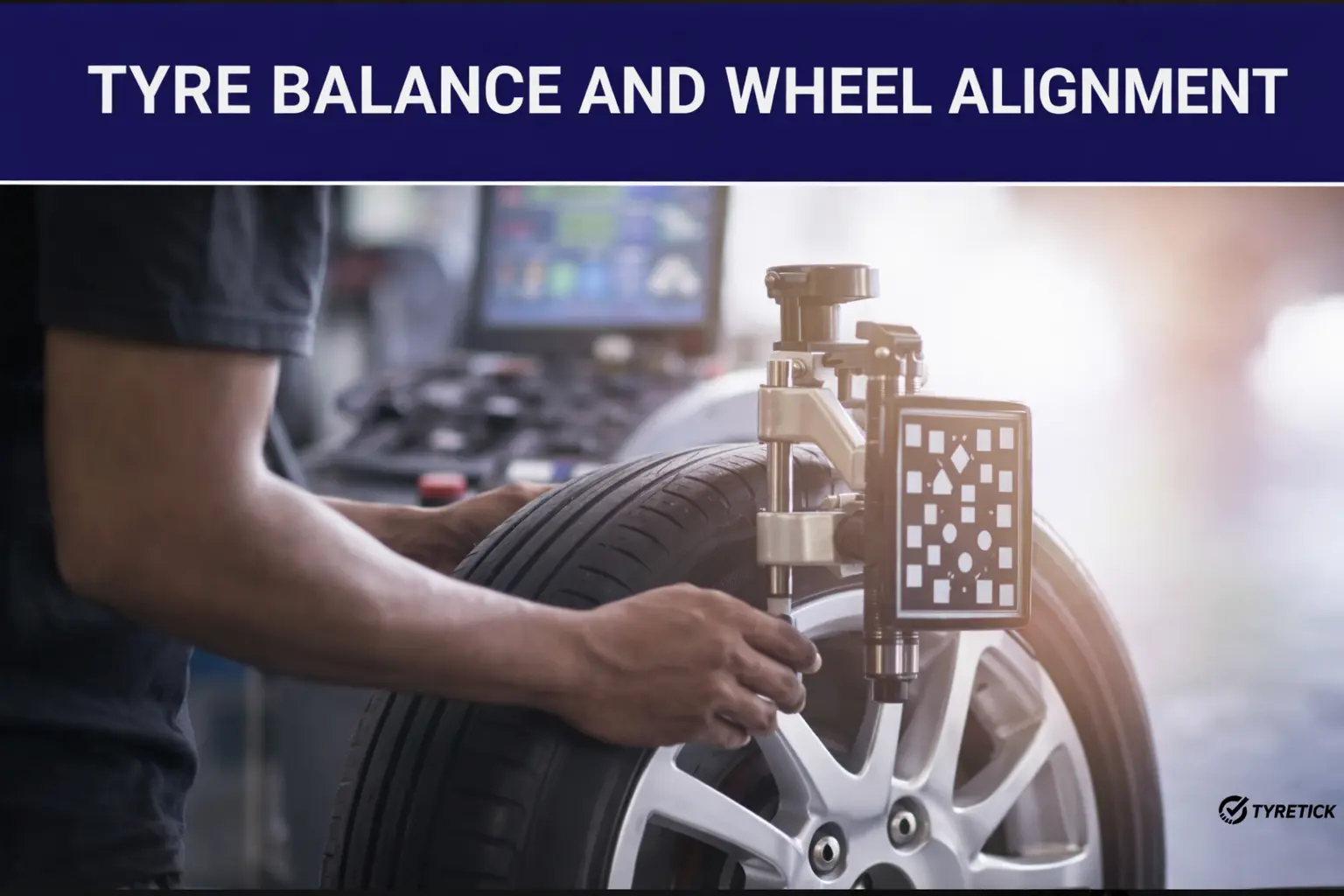
£89 – that’s what my mate paid for a wheel alignment last month after ignoring the issue for six months. His front tyres? Completely worn down on the inside edge. Had to replace them too. Total cost? £389.
He could’ve just paid £89 if he’d fixed it when his car first started pulling to the left.Here is everything you need to know abouttyre balancing and wheel alignment before you end up like him.
What’s Actually Wrong When Your Steering Feels Off
Your steering wheel shouldn’t vibrate at motorway speeds. Your car shouldn’t pull to one side. And your tyres definitely shouldn’t wear unevenly.
When any of these happen, you’ve got one of two problems: unbalanced tyres or misaligned wheels.
They’re not the same thing. But they’ll both cost you money if you ignore them.
Tyre Balancing And Why Your Steering Wheel Shakes
Tyre balancing is crucial for a smoother drive and improved control. Here’s why it matters.
Keeps the Weight Even
Tyre balancing makes sure the weight is spread out evenly across your wheel and tyre.
Even New Tyres Aren’t Perfect
Brand-new tyres can still be off by 15-30 grams, even though they’re fresh from the factory.
Small Imbalance, Big Wobble
It might seem like a tiny amount, but at 70mph, that little imbalance can make your steering wheel (and sometimes the whole car) shake.
Important for Performance
When your performance tyres are properly balanced, you get better grip and handling. Without it, you’re basically fighting the wheel instead of having smooth control.
The Fix is Quick
The process involves spinning your wheel on a balancing machine and adding small weights to the rim to correct the imbalance. It takes just about 10 minutes per wheel.
Wheel Alignment And Why Your Car Drifts
Wheel alignment (also called tracking) adjusts the angle of your wheels relative to each other and the road. Three angles matter: camber, toe, and caster.
You don’t need to understand what those mean. You just need to know when they’re wrong, your car stops driving straight.
Hit a pothole hard enough? Your alignment’s probably off. Scrape a kerb? Same thing. Even normal driving gradually knocks your wheels out of spec over time.
Most cars need alignment checked every 12-18 months or after any significant impact.
How to Tell If You Need Balancing or Alignment
Your car tells you what it needs. You just have to listen.
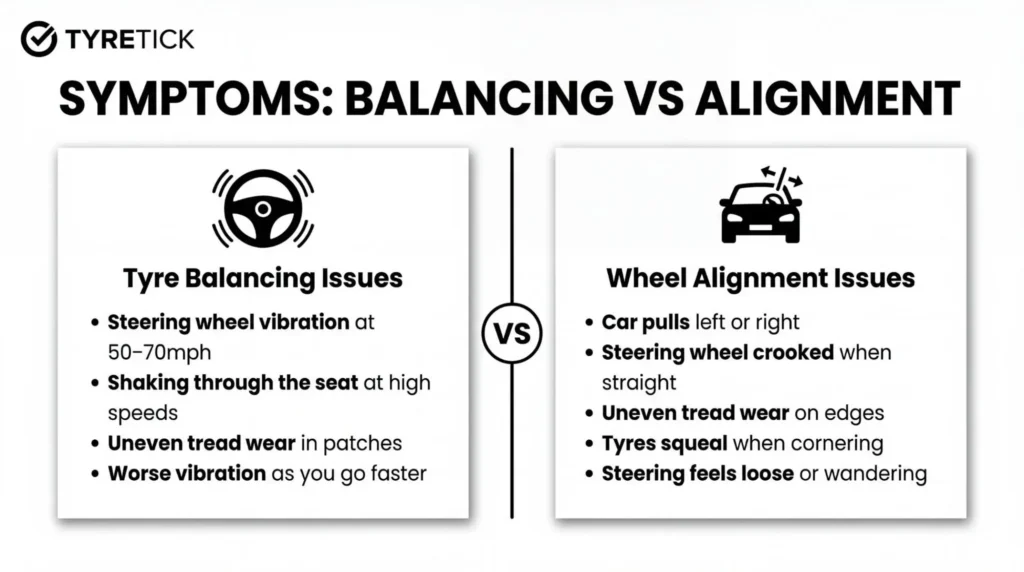
Balancing problems show up as vibration. Alignment problems show up as pulling or drifting.
Sometimes you’ve got both at once. That’s when your car feels properly rubbish to drive.
The good news? Both are fixable in under an hour at any decent mobile tyre service.
Does Wheel Balancing Actually Affect Your Steering
Yes, Unbalanced wheels create vibration that travels straight through your steering column to the wheel in your hands. At low speeds, you might not notice it. At motorway speeds, it’s impossible to ignore.
The vibration isn’t just annoying. It’s dangerous.
Your steering becomes less responsive when the wheel’s shaking. You can’t feel the road properly. Making quick corrections in an emergency becomes harder because you’re already fighting constant movement.
Plus, that constant vibration wears out your suspension components faster. Your shock absorbers, wheel bearings, and steering linkage all take extra punishment from wheels that won’t spin smoothly.
I’ve seen cars with such bad vibration that the owner thought they had a bent wheel or damaged suspension. Turned out to be a simple balancing issue. £40 fixed it.
The Real Cost of Ignoring Balance Issues
Unbalanced tyres wear unevenly. You’ll see flat spots or cupped areas where the tyre’s bouncing against the road instead of rolling smoothly.
That means buying new tyres sooner than you should. We’re talking potentially losing 30-40% of your tyre life because the wear pattern’s already damaged.
Your fuel economy drops, too. Not by much, maybe 2-3%, but it adds up over thousands of miles.
Can Bad Alignment Actually Damage Your Tyres
Absolutely. And it happens faster than you’d think.
Misaligned wheels scrub sideways as they roll. Your tyres are designed to roll straight, not slide at an angle. When the alignment’s off, you’re essentially dragging them down the road at a slight angle.
Check your tyres right now. Run your hand across the tread from inside to outside edge.
Feel any difference? One edge more worn than the other? That’s alignment damage.
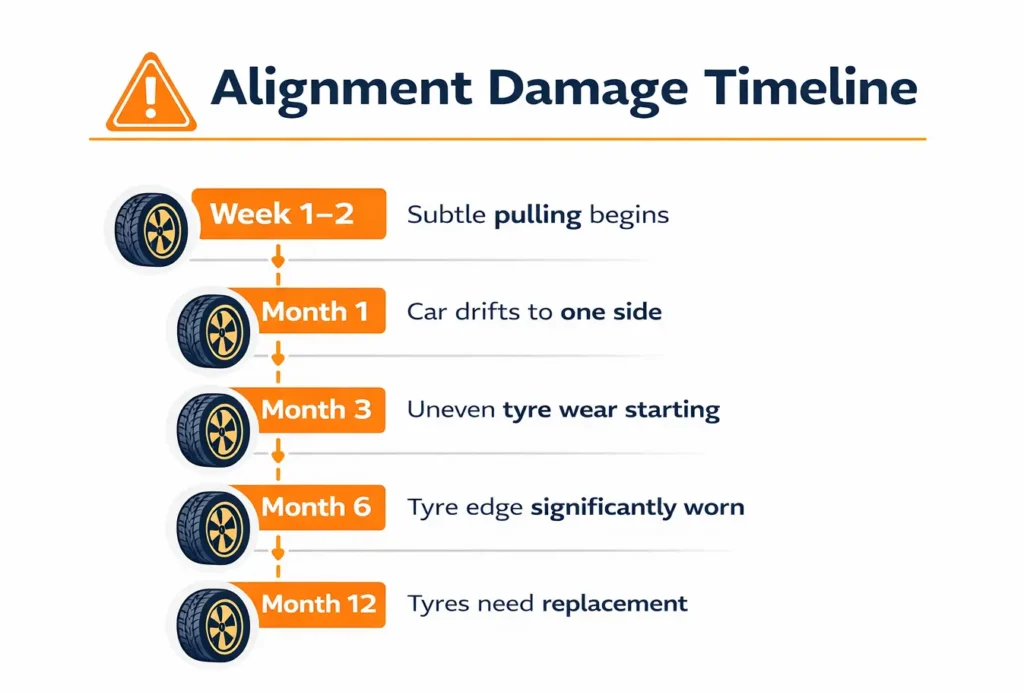
I’ve seen tyres destroyed in six months due to bad alignment. The inside edge is worn down to the cords, while the outside edge looks brand new.
That’s a tyre that should’ve lasted three years, dead in half a year. All because the owner ignored that slight pull to the left.
Your puncture repair won’t last properly on a tyre with uneven wear either. The damaged structure means repairs don’t seal as well.
What Causes Alignment to Go Wrong
Potholes are the main culprit. That hard jolt you feel when you hit one? That’s your suspension getting knocked out of spec.
Speed humps taken too fast do the same thing. Mounting kerbs. Even just the accumulated stress of thousands of miles gradually pushes things out of alignment.
You can’t avoid all of it. But you can get your alignment checked regularly before it ruins your tyres.
Sometimes the clearest explanations come from drivers who have already dealt with the problem. This Reddit discussion shows exactly that.
Do I need to Wheel alignment and Balancing?
byu/Flashy-Butterfly6310 inCartalk
Is Wheel Alignment Actually Necessary
Here’s the thing: your wheels won’t stay aligned forever on their own.
Every car gradually loses alignment through normal driving. Manufacturers build tolerances into the specs, but those tolerances are tight. Most alignment settings need to stay within 0.5 degrees to work properly.
Hit enough bumps and imperfections in the road, and you’ll drift outside those specs. Not might. Will.
The question isn’t whether alignment’s necessary. It’s how often you need it.
The Smart Alignment Schedule
Get your alignment checked when you fit new tyres. Always. Non-negotiable.
Your shiny new performance tyres won’t perform if they’re fighting bad alignment from day one.
Check it annually even if nothing feels wrong. Alignment can drift gradually enough that you don’t notice the change, but your tyres notice. They’ll show uneven wear long before you feel any pulling.
And obviously, check it immediately after hitting a big pothole or mounting a kerb hard. If the impact was strong enough to make you wince, it was strong enough to knock your alignment off.Most good mobile tyre fitters include a free alignment check with new tyres anyway. Takes them five minutes on a machine. Catches problems before they cost you hundreds.
How Long Does Wheel Alignment Actually Take
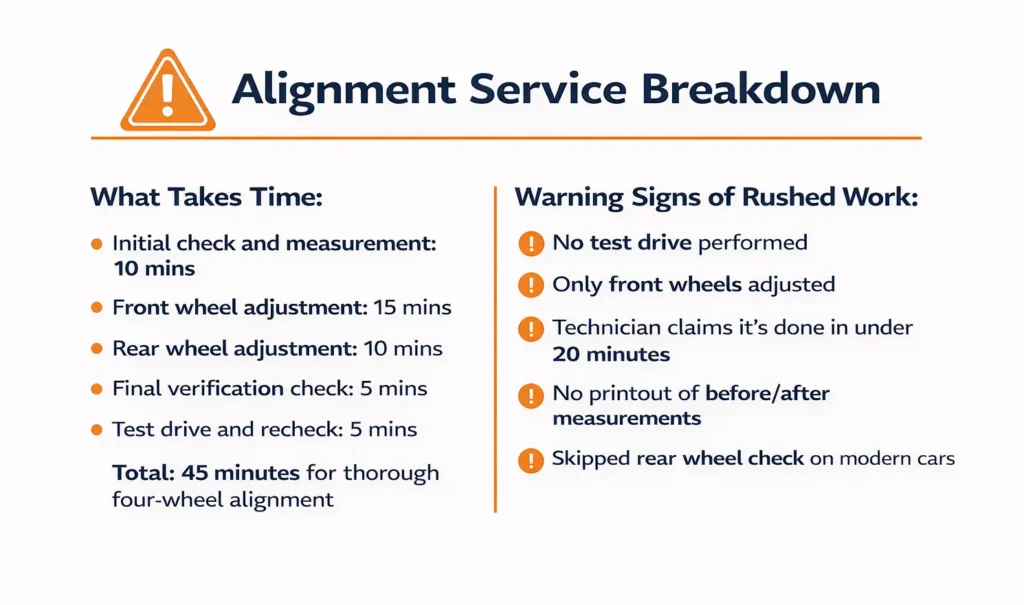
30-45 minutes for a full four-wheel alignment. That’s it.
Some quick-lube places claim they can do it in 15 minutes. They’re lying or cutting corners. Proper alignment requires precision measurements and careful adjustments.
Your tech needs to:
Check current alignment settings on all four wheels, adjust front wheel angles (camber, caster, toe), adjust rear wheel angles on most modern cars, verify everything’s within spec, and test-drive to confirm.
Rush that process and you’ll be back next month because it wasn’t done properly.
The Mobile Tyre Advantage
Here’s where mobile tyre services make life easier. They come to your house or workplace with all the alignment equipment in the van.
You don’t waste time driving to a garage, sitting in a waiting room, driving home. You keep working or relaxing while they sort your car.For complete mobile tyre fitting services, you’re looking at the same time frame. But that time’s happening in your driveway while you do something useful.
What Happens If You Balance But Don’t Align (Or Vice Versa)
You fix half the problem and wonder why your car still drives like rubbish.
Balanced tyres on misaligned wheels will roll smoothly but wear unevenly and pull to one side. You’ve solved the vibration but not the pulling or tyre wear.
Aligned wheels with unbalanced tyres will track straight but shake like crazy at speed. You’ve fixed the pulling but your steering wheel still vibrates.
They’re different problems needing different solutions.
When You Need Both
Fitting new tyres? You need both balancing and alignment. Every time. No exceptions.
The balancing makes sure your new tyres roll smoothly. The alignment makes sure they wear evenly and last their full lifespan.
Most professional mobile tyre services bundle both together anyway. It’s standard practice because doing one without the other is pointless.
If you’ve hit a major pothole, check alignment first. If your steering’s been vibrating but the car drives straight, check balancing first.
Still not sure? Just get both checked. A visual inspection and basic measurement costs nothing at most places.
The Hidden Costs of Bad Balance and Alignment
Your tyres are the obvious victim. But they’re not the only victim.
Suspension components work harder when wheels aren’t balanced properly. Shock absorbers get hammered by constant vibration. Wheel bearings wear faster. Even your steering rack takes extra punishment.
I’ve seen suspension repairs run £400-600 that could’ve been avoided with £90 worth of preventive alignment.
Your fuel economy suffers too. Misaligned wheels create extra rolling resistance. Your engine works harder to maintain speed. Over a year, that’s potentially £100-150 in wasted fuel for the average driver.
And your safety takes a hit. A car that pulls or vibrates doesn’t handle emergencies as well. Your stopping distances increase slightly. Your ability to make quick steering corrections decreases.
- All fixable.
- All preventable.
What Good Balance and Alignment Actually Feel Like
Your car should drive straight with light pressure on the wheel. Not wandering. Not fighting you.
Take your hands off the wheel briefly on a straight, level road. The car should keep going straight for at least 3-4 seconds before drifting slightly.
Your steering wheel should sit perfectly centered when driving straight. Not cocked 10 degrees to the left or right.
At motorway speeds, your steering should feel solid and smooth. No vibration. No shaking. Your performance tyres should grip predictably through corners.
When you brake hard in a straight line, the car should track straight without pulling left or right.
That’s what properly balanced and aligned wheels feel like. Anything less means something needs attention.
The Bottom Line on Balance and Alignment
Your car needs both to drive properly and protect your tyres.
Balancing stops vibration. Alignment stops pulling and uneven wear. Neither is optional if you want your tyres to last their full lifespan.
Get them checked when you fit new tyres, annually, and after any hard impact. The £90 you spend on alignment saves you £300 on premature tyre replacement.
Your steering should feel solid and responsive. Your car should track straight without constant correction. Anything less means you need to book an appointment with a mobile tyre specialist before small problems become expensive ones.
Don’t be like my mate who waited six months. Sort it now while it’s still cheap.
Common Questions About Balance and Alignment
How often should I get my wheels balanced?
Every time you fit new tyres. And if you start feeling vibration at speed. Some people balance every 6,000 miles as preventive maintenance, but that’s probably overkill unless you drive on particularly rough roads.
Can I balance my own wheels?
Not without a £2,000+ balancing machine. This isn’t a DIY job. Even if you had the equipment, getting it right requires practice and precision.
Does wheel alignment fix pulling caused by crosswinds?
No. Every car gets pushed around a bit in strong crosswinds. If your car pulls in calm conditions, that’s alignment. If it only pulls when windy, that’s just physics.
Will new tyres fix alignment issues?
Nope. New tyres on misaligned wheels will just wear out unevenly like the old ones did. Fix the alignment first, then the new tyres will last properly.
How do I know if it’s alignment or something else?
Alignment causes consistent pulling in one direction. Other problems (like a sticking brake caliper) might cause pulling that comes and goes. Uneven tyre pressure or damage can mimic alignment issues, too. Check your pressures first, it’s free.
Should I rotate tyres before or after alignment?
After. Get your alignment sorted, then rotate if needed. No point rotating unevenly worn tyres onto different positions before fixing what caused the uneven wear.
