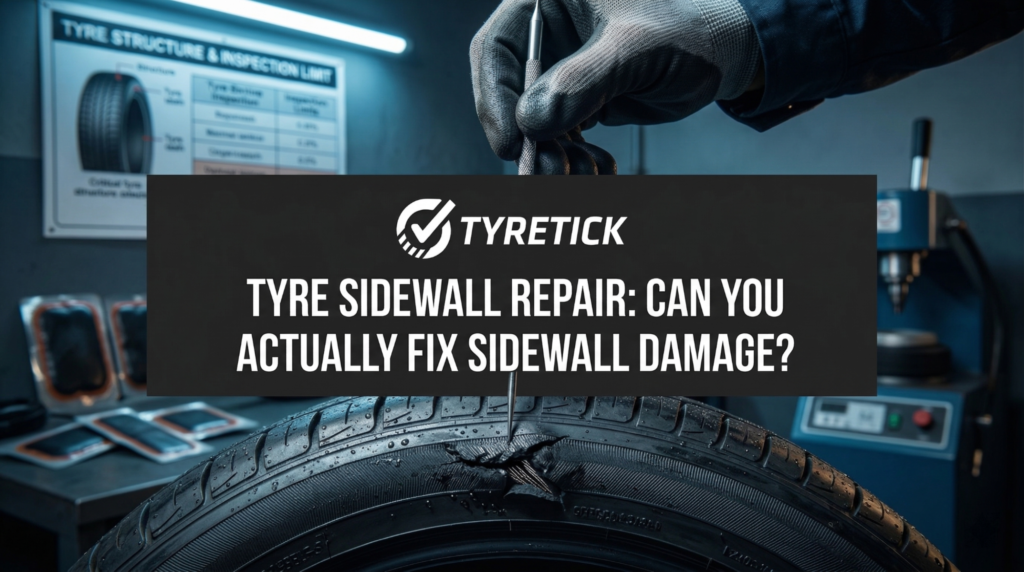
Your sidewall’s damaged. Now what?
Here’s the honest answer. You can’t repair it.
Tyre sidewall damage means one thing. Replacement. No patch, no plug, no sealant kit will fix a damaged sidewall safely. That’s not opinion. That’s UK law under British Standard BSAU159. And if you’re stuck in London, 24/7 emergency mobile tyre fitting gets you sorted fast. At your location.
Let’s break down exactly why sidewall repair doesn’t work, what the law says, and what to do next.
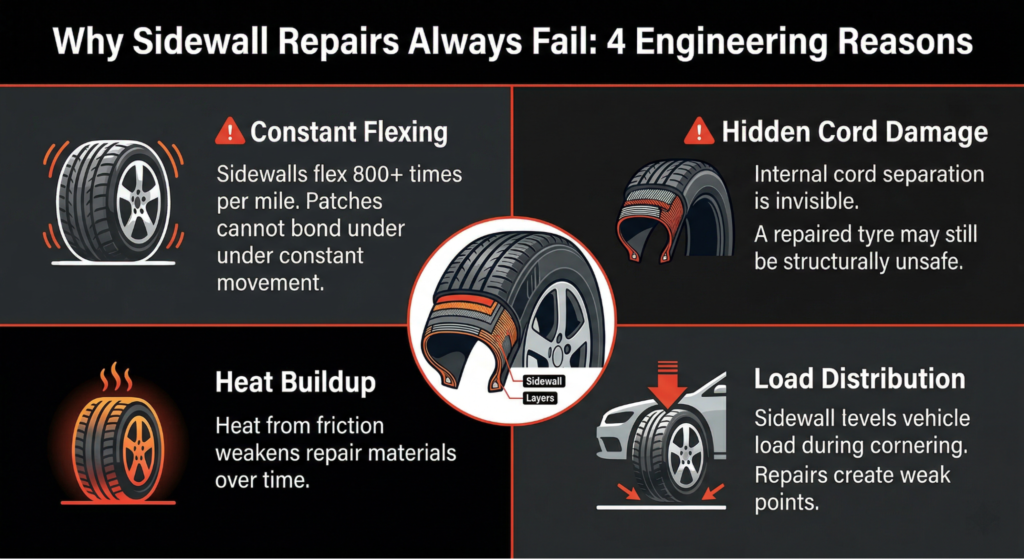
Why Tyre Sidewall Repair Doesn’t Work: The Engineering Reality
Most drivers think a sidewall cut is just like a tread puncture. It’s not. Not even close.
Your tyre’s sidewall is the structural backbone of the entire tyre. It flexes constantly. It absorbs kerb impacts. It supports the full weight of your car during cornering.
What’s Inside Your Sidewall
Under that smooth rubber? Layers of reinforced cords. These cords maintain the tyre’s shape under pressure. They’re what keeps 32 PSI of air inside a thin rubber shell moving at 70mph.
Damage those cords? The tyre loses structural integrity. Permanently.
A tread puncture sits in the thickest, most reinforced part of the tyre. Patches and plugs work there because the area doesn’t flex much. Sidewalls? Constant flexing. Every bump. Every turn. Every mile.
That’s why any repair attempt fails. The patch peels. The plug shifts. And suddenly you’re looking at a blowout at motorway speed.
Tread Repair vs Sidewall Repair: Why One Works and One Doesn’t
| Factor | Tread Puncture | Sidewall Damage |
| Repairability | Yes (central ¾ area) | No. Never. |
| Flexing | Minimal | Constant, extreme |
| Cord damage risk | Low (if small) | High (almost certain) |
| Patch durability | Reliable long-term | Fails quickly |
| UK legal repair? | Yes (under BSAU159) | No |
| Safe to drive on? | Yes (after proper repair) | No. Replace immediately. |
See the difference? It’s not a technicality. It’s physics.
UK Law on Tyre Sidewall Damage: What BSAU159 Actually Says
This isn’t optional. It’s the law.
British Standard BSAU159 governs all tyre repairs in the UK. And it’s very clear on sidewalls.
The Minor Repair Area Rule
Only the central ¾ of the tyre tread counts as the “minor repair area.” Everything outside that zone? Unrepairable. Legally. That includes the entire sidewall and the shoulder area where tread meets sidewall. If your puncture repair falls outside this zone, replacement is the only option.
Size Limits That Matter
Even within the repair zone, damage larger than 6mm in diameter can’t be fixed. Splits, cuts, and gouges? Also unrepairable. Regardless of location.
Penalties for Driving on Damaged Sidewalls
Get caught driving with sidewall damage in the UK? Here’s what you’re facing.
| Penalty | Details |
| Fine | Up to £2,500 per tyre |
| Penalty points | 3 points per defective tyre |
| MOT result | Automatic fail |
| Insurance | Claim may be invalidated |
| Worst case | 4 illegal tyres = 12 points = licence gone |
That’s £10,000 and a ban. For tyres.
Wondering if you can drive on it temporarily? Read our guide on whether you can drive with a punctured tyre. Short answer: don’t.
Types of Tyre Sidewall Damage: Which Ones Are Dangerous?
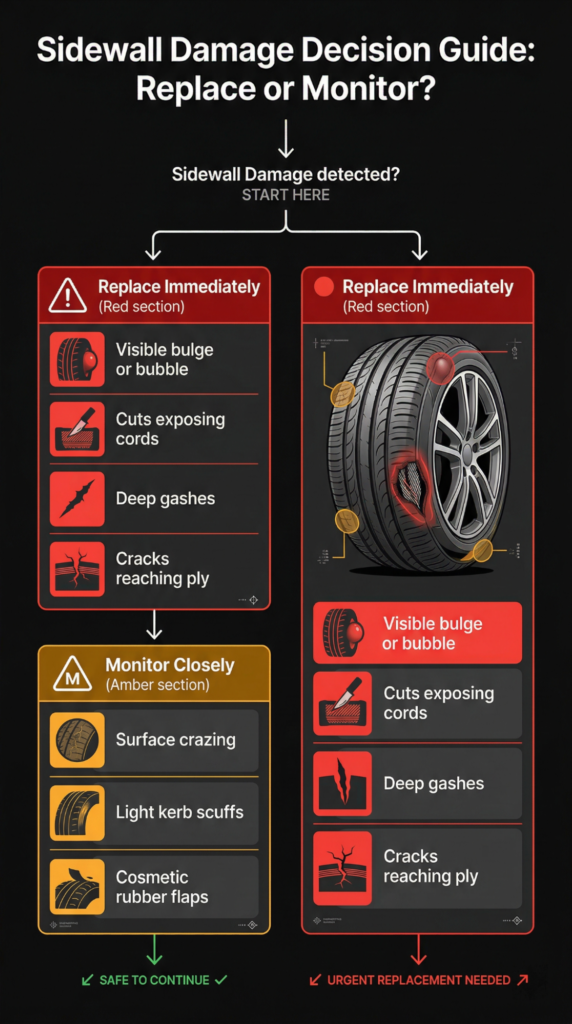
Not all sidewall damage looks the same. But almost all of it means the same thing. Replace.
Cuts and Gashes
Road debris does this. Glass, metal, sharp stones. If the cut exposes internal cords, it’s an MOT fail. Immediately. Even shallow cuts weaken the structure over time. And you can’t always tell the depth by looking.
Bulges and Bubbles
Hit a pothole at speed? Clipped a kerb hard? Check your sidewalls.
A bulge means the internal cords have snapped. Air pushes through the weakened area and creates a visible bump. This is the most dangerous type of sidewall damage. Blowout risk is real. And sudden.
Cracks and Crazing
Older tyres develop cracks from UV exposure and rubber degradation. Fine surface crazing? Usually just cosmetic. Deep cracks that reach the cords? That’s a fail.
Scrapes and Scuffs
Kerbing damage. We’ve all done it. Light scuffs on the rim protector usually aren’t structural. But deep scrapes that remove chunks of rubber? Get them checked. Immediately.
| Damage Type | Common Cause | Repairable? | Danger Level | Action Needed |
| Cut / gash | Road debris, glass | No | High | Replace tyre |
| Bulge / bubble | Pothole, kerb impact | No | Very high | Replace immediately |
| Deep crack | Age, UV, chemicals | No | High | Replace tyre |
| Surface crazing | Normal ageing | Monitor only | Low | Check regularly |
| Light scuff | Kerb contact | Monitor only | Low | Professional check |
What Causes Tyre Sidewall Damage? The 6 Main Culprits
Prevention beats replacement. Every time. Here’s what actually damages sidewalls.
1. Kerb Strikes
The number one cause. Parking too close. Tight turns. Parallel parking mishaps. Each impact can crack internal cords without visible external damage.
2. Potholes
London’s roads are brutal. A pothole at speed compresses the sidewall between the rim and road surface. That’s how bulges form. One bad pothole can destroy a brand new tyre.
3. Underinflation
Running low on pressure? Your sidewalls flex more than they should. Excessive flexing generates heat. Heat weakens rubber. Weakened rubber cracks and fails. Check your pressures monthly. Or better yet, let a mobile tyre fitting service handle it.
4. Road Debris
Glass. Metal fragments. Construction waste. Sharp objects slice into sidewalls with zero warning. And unlike tread punctures, there’s no safe repair.
5. Age and UV Exposure
Rubber degrades. Period. UV sunlight accelerates it. Tyres parked outdoors for years develop micro-cracks that eventually become structural failures. The general recommendation? Replace tyres older than 5 years. Regardless of tread depth.
6. Overloading
Stuffing your car beyond its weight rating puts massive stress on sidewalls. Holiday road trips with the boot packed to the ceiling? That’s sidewall stress territory.
What About DIY Sidewall Repair Kits? Do They Work?
No. Full stop.
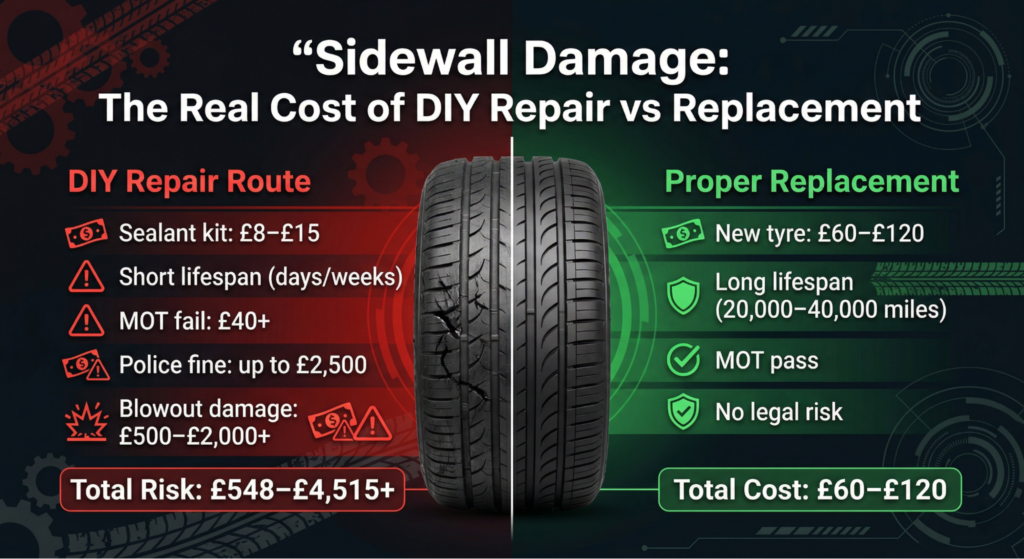
Let’s be brutally honest here. Tyre sealant kits, plug kits, rubber cement, superglue, sidewall patches from eBay? None of these provide a safe, lasting repair on a sidewall.
Why Sealant Kits Don’t Work on Sidewalls
Sealant kits are designed for small tread punctures. The liquid fills the hole from inside. But sidewall damage isn’t a simple puncture. It’s structural compromise. Sealant can’t rebuild broken cords. It can’t restore structural integrity. And it definitely can’t survive the constant flexing.
The Superglue Myth
You’ll find forum posts from drivers who superglued a sidewall flap and drove on it for months. Some got lucky. Others didn’t. Here’s the thing: luck isn’t a safety strategy. A blowout at 70mph on the M25 can kill.
Don’t gamble your safety to save £60-£120 on a replacement.
Tyre Sidewall Damage Fix: What You Should Actually Do
Damaged sidewall? Here’s your step-by-step action plan.
Step 1: Stop Driving
Seriously. Pull over safely. Don’t push it to the next junction. Don’t limp home. Every mile on a damaged sidewall increases blowout risk.
Step 2: Assess the Damage
Look for these signs:
- Visible bulges or bubbles on the sidewall
- Cuts deep enough to see fabric or cord underneath
- Large chunks of rubber missing
- Rapid air loss
Any of these? You need a replacement. Not a repair.
Step 3: Use Your Spare or Call Mobile Fitting
Got a spare? Fit it. No spare? That’s where home tyre fitting saves the day. A mobile fitter comes to your exact location. Wherever you are. 30-45 minutes and you’re back on the road. With a brand new tyre.
Step 4: Get the Right Replacement
Match your existing tyre size, speed rating, and load index. Don’t mix brands on the same axle if you can avoid it. Need help choosing? Premium brands like Michelin and Continental offer the best wet grip and longevity for London driving.
Car Tyre Sidewall Repair Cost vs Replacement Cost: The Real Numbers
Let’s talk money. Because that’s usually why people search for sidewall repairs.
| Option | Cost | Safety | Legal? | Lasts? |
| DIY sealant kit | £8-£15 | Dangerous | No (on sidewall) | Days at best |
| Budget tyre replacement | £45-£70 fitted | Safe | Yes | 20,000-25,000 miles |
| Mid-range tyre replacement | £70-£100 fitted | Safe | Yes | 25,000-35,000 miles |
| Premium tyre replacement | £100-£160 fitted | Safe | Yes | 30,000-40,000 miles |
| Mobile fitting (any tyre) | £60-£120 total | Safe | Yes | Full tyre lifespan |
Bottom line? Replacement is cheaper than a £2,500 fine. And infinitely cheaper than an accident.
Plus, with mobile tyre replacement in London, you don’t waste 2-3 hours at a garage. The fitter comes to you. At your house, office, or roadside.
How to Prevent Tyre Sidewall Damage: 7 Expert Tips
You can’t repair sidewall damage. But you can prevent it. Here’s how.
1. Check Tyre Pressures Monthly
Underinflation is the silent killer. Low pressure means excessive sidewall flex. Excessive flex means heat. Heat means failure. Check every 4 weeks. Simple.
2. Avoid Kerbs
Easier said than done in London. But every kerb strike chips away at sidewall integrity. Leave extra space when parking. Take wider turns.
3. Watch for Potholes
Slow down when road conditions are poor. A pothole at 40mph can destroy a sidewall instantly. At 15mph? Usually survivable.
4. Don’t Overload
Check your car’s maximum load rating. It’s in the handbook. Heavy loads stress sidewalls beyond their design limits.
5. Park in Shade
UV degrades rubber. Long-term outdoor parking accelerates sidewall cracking. Use covered parking when possible.
6. Inspect Tyres Regularly
Walk around your car once a week. Look at each sidewall. Both sides. Inner sidewall damage is invisible unless you look for it.
7. Replace Tyres Before They’re Too Old
Even if tread looks fine, rubber degrades. Most experts recommend replacement after 5 years. The tyre’s age code is on the sidewall. Four digits. Week and year of manufacture. If you’re unsure, book a mobile tyre check and we’ll tell you exactly where you stand.
Run Flat Tyres and Sidewall Damage: A Different Story?
Sort of. But not really.
Run flat tyres have reinforced sidewalls. They’re designed to support the car’s weight even with zero air pressure. So if you get sidewall damage, you can drive slowly to safety. About 50 miles at 50mph maximum. That’s the advantage. But here’s the catch. Damaged run flats still need full replacement. The reinforced sidewall helps you get home. It doesn’t make the tyre repairable. And run flats must be replaced with other run flats. Always. Your mobile wheel balancing service can handle the whole job at your location.
Frequently Asked Questions About Tyre Sidewall Repair
Q: Can you repair a tyre sidewall?
No. UK law under BSAU159 prohibits sidewall repairs. The sidewall’s constant flexing makes any repair unsafe. You need a full tyre replacement.
Q: How much does tyre sidewall puncture repair cost?
There’s no such thing as a legitimate sidewall puncture repair. Replacement costs £45-£160 depending on tyre brand and size. Mobile fitting costs £60-£120 total, including the tyre and fitting at your location.
Q: Is it safe to drive with a small cut on the sidewall?
Depends on depth. A surface scratch that doesn’t expose cords? Probably fine to monitor. A cut deep enough to see fabric underneath? Stop driving. Replace the tyre. If you’re unsure, don’t risk it. Call for emergency tyre replacement.
Q: Will a tyre with sidewall damage fail the MOT?
Yes. Bulges, deep cuts, exposed cords, or structural damage on the sidewall result in an automatic MOT fail. Minor surface crazing may get an advisory but won’t fail.
Q: Can I use tyre sealant on sidewall damage?
No. Sealant is designed for small tread punctures only. It won’t hold on a sidewall. And it definitely won’t pass a professional inspection.
Q: How fast can I get a sidewall-damaged tyre replaced in London?
With Tyretick’s 24/7 mobile service, a fitter can reach most London locations in 25-50 minutes. The replacement takes another 30-45 minutes. You’re back on the road in about an hour. Total.
The Bottom Line on Tyre Sidewall Repair
Can you repair a tyre sidewall? No. Not safely. Not legally. Not practically.
Sidewall damage means replacement. Every time. No exceptions.
The good news? Getting sorted is fast and affordable. Especially with mobile fitting. No garage trip. No waiting room. No wasted afternoon.
Need a sidewall-damaged tyre replaced? Contact Tyretick for fast, 24/7 mobile tyre fitting across London. We come to you. We bring the tyres. We get you moving. Simple.