Your steering wheel vibrates at 60mph.
Your car drifts left. Constantly.
Two problems. Two completely different fixes.
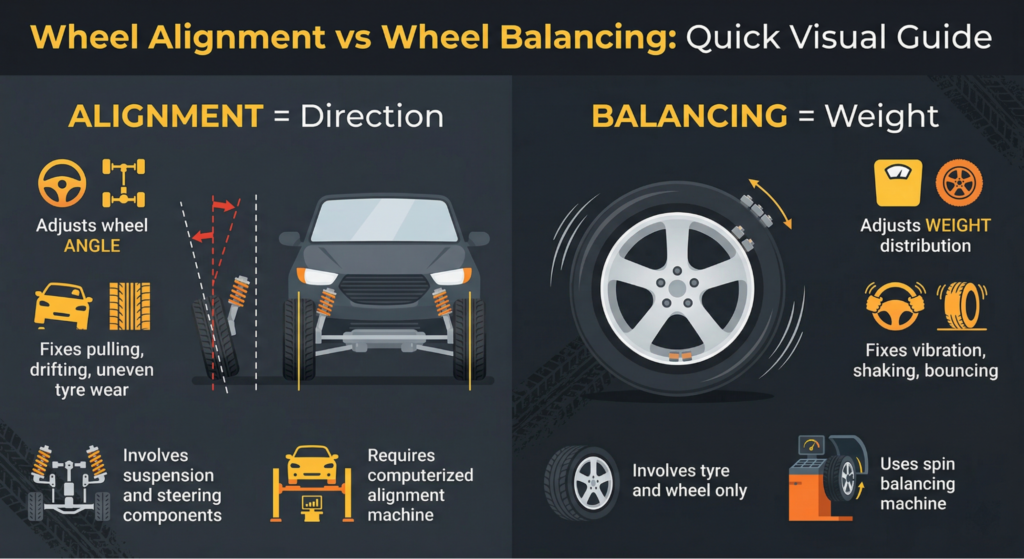
Wheel alignment adjusts your suspension angles. Wheel balancing corrects weight distribution around the tyre. Mix them up? You’ll waste money fixing the wrong thing. And your mobile tyre fitting technician will tell you the same.
Here’s how to tell them apart. Fast.
Wheel Alignment vs Wheel Balancing: The 30-Second Explanation
Most drivers confuse these two. Understandable.
They sound similar. They both affect how your car drives. But they fix completely different problems.
What Wheel Alignment Actually Does
Alignment has nothing to do with your wheels. Surprising? It’s about your car’s suspension system. The suspension connects your wheels to the vehicle. When it shifts, your wheels point in slightly wrong directions.
A mechanic adjusts three angles during alignment:
- Camber: the inward or outward tilt of your tyre when viewed from the front
- Toe: whether your tyres point inward or outward when seen from above
- Caster: the angle of your steering axis from the side view
Get these wrong? Your tyres wear unevenly. Your car pulls sideways. Fuel economy drops.
What Wheel Balancing Actually Does
Balancing is simpler. It’s about weight distribution.
No tyre is perfectly manufactured. Some spots are slightly heavier. Others slightly lighter. At speed, these tiny differences cause vibration. A mobile wheel balancing technician spins each wheel on a machine, finds the heavy spots, then attaches small metal weights to even everything out.
Done. Smooth ride restored.
Side-by-Side Comparison
| Feature | Wheel Alignment | Wheel Balancing |
| What it adjusts | Suspension angles (camber, toe, caster) | Weight distribution around wheel |
| What it fixes | Car pulling, uneven tyre wear, steering drift | Vibration, shaking, bouncing at speed |
| Equipment needed | Computerised alignment rack | Spin balancing machine |
| Time required | 45–90 minutes | 15–30 minutes |
| Cost (UK average) | £40–£100 (4-wheel) | £5–£10 per wheel |
| How often needed | Every 10,000 miles or annually | Every 5,000–10,000 miles |
| Can be done mobile? | Rarely (needs fixed rack) | Yes (portable balancer) |
See the difference? Completely separate services. Completely different equipment.
5 Warning Signs Your Car Needs Wheel Alignment
Don’t guess. Watch for these.
1. Your Car Pulls to One Side
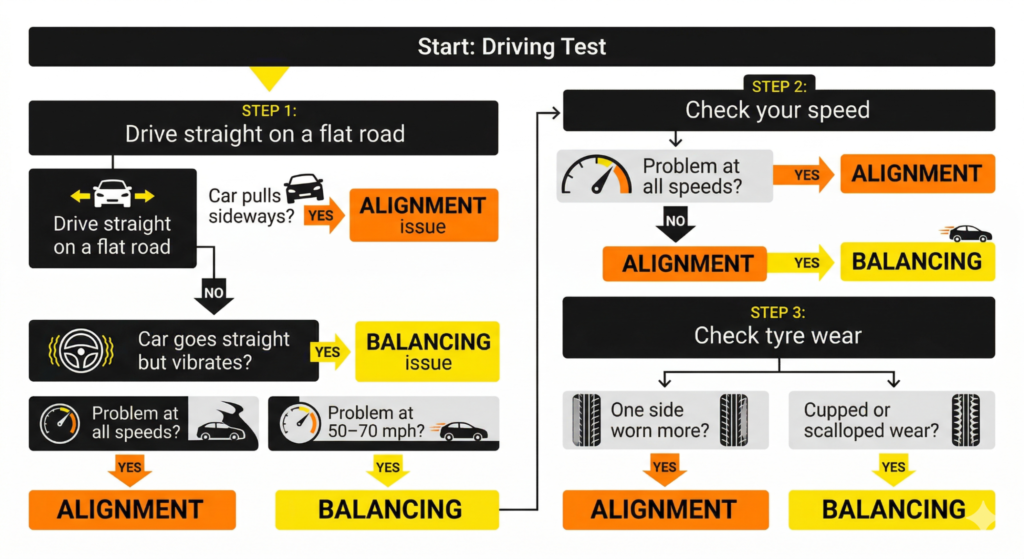
Driving on a straight, flat road. Hands slightly loose on the wheel. The car drifts left. Or right.
That’s misalignment. Classic symptom. The toe angle is off, forcing your tyres to fight each other instead of rolling parallel.
2. Uneven Tyre Wear Patterns
Check your front tyres. Is one edge significantly more worn than the other? That’s camber misalignment. Inner edge wear means negative camber. Outer edge? Positive camber. Either way, you’re burning through tyres faster than necessary.
3. Steering Wheel Off-Centre
You’re driving straight. But your steering wheel logo sits at an angle. Tilted. That’s a dead giveaway.
The toe alignment is wrong. Your wheels aren’t parallel.
4. Steering Feels Loose or Unresponsive
You turn the wheel. There’s a delay. The car responds slowly. Feels mushy. Imprecise.
Misalignment reduces steering precision. Dangerous in emergency situations.
5. Recent Pothole Impact or Kerb Hit
Hit a pothole hard? Clipped a kerb? London roads are brutal. One solid impact can shift your alignment instantly. If you’ve had a bump recently, get it checked. Our 24/7 emergency tyre service can assess the damage fast.
4 Signs Your Wheels Need Balancing
Different symptoms. Pay attention.
1. Steering Wheel Vibration at Speed
This is the big one. You hit 50–60mph. Your steering wheel starts shaking. Gets worse at 65–70mph. Then sometimes disappears above 75mph.
That pattern? Almost always unbalanced front wheels.
2. Seat or Floor Vibration
Vibration through the seat? Or the floorboard? That usually points to rear wheel imbalance. The front wheels affect the steering column. Rear wheels vibrate through the chassis.
3. Cupped or Scalloped Tyre Wear
Run your hand across the tyre tread. Feel dips and high spots? Like a scallop pattern? That’s classic imbalance wear. One section of the tyre hits the road harder on every rotation.
4. Humming or Buzzing From Wheels
A constant hum that changes with speed. Not a squeal. Not a grinding. A rhythmic buzz. Your wheels are telling you something’s off.
Quick Diagnosis Table
| Symptom | Likely Cause | Which Service? |
| Car pulls left or right | Toe or camber misalignment | Wheel alignment |
| Steering wheel off-centre | Toe misalignment | Wheel alignment |
| Vibration at 50–70mph | Weight imbalance (front) | Wheel balancing |
| Seat vibration at speed | Weight imbalance (rear) | Wheel balancing |
| One-sided tyre wear | Camber misalignment | Wheel alignment |
| Scalloped tyre wear | Imbalanced wheels | Wheel balancing |
| Loose steering feel | Multiple angle misalignment | Wheel alignment |
| Humming from wheels | Dynamic imbalance | Wheel balancing |
Not sure which one you need? Contact our mobile fitting team. We’ll diagnose it at your location.
How Each Procedure Works: Step-by-Step Breakdown
Knowing the process helps you understand the cost difference. And spot a rushed job.
The Wheel Alignment Procedure
This one takes time. Proper equipment. Expertise.
Pre-Alignment Checks
A good technician doesn’t start adjusting immediately. First comes inspection:
- Tyre pressure check (all four wheels)
- Tyre condition assessment
- Suspension component inspection
- Steering linkage examination
- Check for bent or damaged wheels
Why? Because aligning wheels on worn suspension is pointless. The alignment won’t hold. Money wasted.
The Alignment Process
Your car goes onto an alignment rack. Sensors attach to each wheel. A computer reads the current angles.
The technician sees exactly how far off each angle is. Then adjusts:
- Track rods for toe angle correction
- Control arms or bolts for camber adjustment
- Struts for caster modification (when adjustable)
Final step? A test drive to confirm everything tracks straight. The whole process takes 45–90 minutes for a 4-wheel alignment.
The Wheel Balancing Procedure
Faster. Simpler. But still requires precision.
The Balancing Process
Each wheel comes off your car. Gets mounted on a spin balancing machine.
The machine spins the wheel at high speed. Sensors detect exactly where the heavy and light spots are. Down to the gram.
Then the technician attaches small metal weights to the rim. Clip-on or adhesive. Positioned precisely where the machine says.
One more spin to verify. Balanced. Back on the car. Takes about 15–30 minutes for all four wheels. That’s why mobile wheel balancing services are so practical. Portable balancers deliver the same accuracy as garage equipment.
Procedure Comparison at a Glance
| Detail | Wheel Alignment | Wheel Balancing |
| Pre-checks required | Suspension, steering, tyre condition | Tyre condition only |
| Equipment | Computerised alignment rack | Spin balancing machine |
| What’s adjusted | Suspension angles (toe, camber, caster) | Weight placement on rim |
| Parts used | None (adjustment only) | Small metal weights |
| Time per car | 45–90 minutes | 15–30 minutes |
| Can be done at home? | Rarely | Yes (mobile service) |
| Test drive needed? | Yes (to verify) | No (machine verifies) |
Real Costs in London: What You’ll Actually Pay
Let’s talk money. No vague ranges. Real numbers.
Wheel Alignment Costs
In the UK, alignment prices depend on whether you need front-only or four-wheel service.
| Alignment Type | Average Cost | Range | Time |
| Front wheel only | £45–£50 | £30–£60 | 30–45 mins |
| Front + rear (4-wheel) | £70–£90 | £50–£100 | 45–90 mins |
| Premium/performance car | £100–£150 | £85–£150+ | 60–120 mins |
London garages charge more. Expect the higher end of these ranges. That’s standard for the city.
Wheel Balancing Costs
Much cheaper. Significantly.
| Service | Cost Per Wheel | All 4 Wheels | Notes |
| Standard balancing | £5–£10 | £20–£40 | Most common |
| With new tyre fitting | Usually included | Free with purchase | Always confirm |
| Road force balancing | £15–£25 | £60–£100 | Premium service |
| Mobile balancing | £8–£12 | £32–£48 | At your location |
Here’s the thing. Wheel balancing is usually included when you buy new tyres. So if you’re getting new tyres fitted at home, balancing should come standard. Always ask.
Why Wheel Balancing Matters More Than Most Drivers Think
People skip balancing. Bad move.
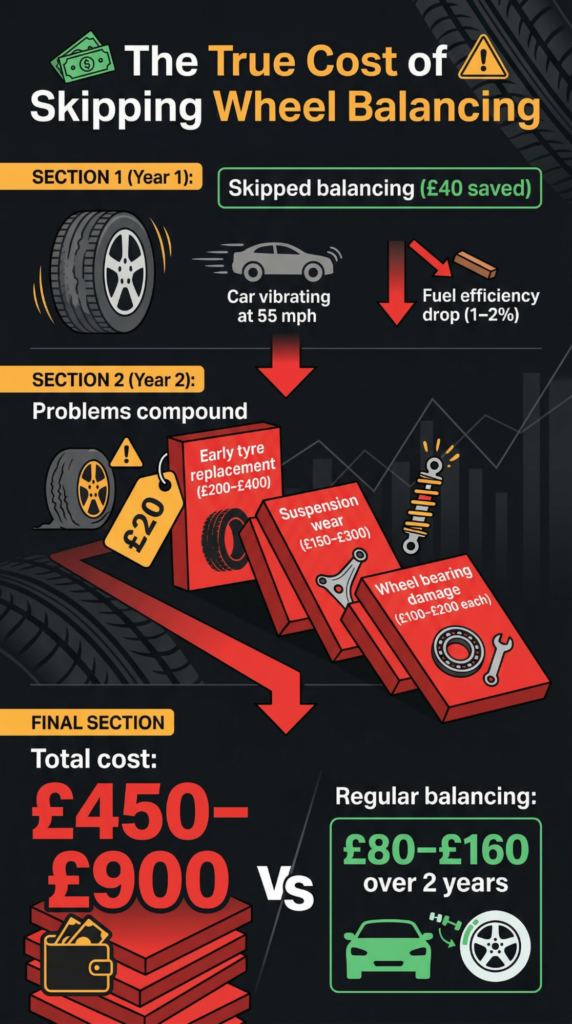
An unbalanced wheel spinning at 60mph creates massive force. We’re talking repetitive impacts on your suspension, bearings, and steering components every single second.
The Hidden Costs of Ignoring Imbalance
- Tyre replacement 15–20% sooner (cupped wear)
- Suspension component damage (£200–£500 to fix)
- Wheel bearing wear (premature replacement)
- Increased fuel consumption (1–3% efficiency loss)
- Reduced braking effectiveness
A £20–£40 balancing job prevents hundreds in damage. Simple maths.
When to Get Wheels Balanced
- Every time you fit new tyres
- After hitting a significant pothole
- Every 5,000–10,000 miles
- If you feel vibration at speed
- After seasonal tyre swaps
- When rotating tyres
Driving in London means potholes. Constantly. All-season tyres handle the conditions well, but they still need regular balancing after those inevitable impacts.
Do You Need Both Alignment and Balancing at the Same Time?
Sometimes. Not always.
Here’s when you should get both together:
- New tyre installation (balancing always, alignment recommended)
- After a significant pothole or kerb impact
- Annual tyre health check
- If you’re experiencing both pulling AND vibration
Here’s when you probably need just one:
Alignment Only
- Car pulls to one side but rides smooth
- Uneven wear on tyre edges only
- Steering wheel sits off-centre
Balancing Only
- Vibration at speed but car tracks straight
- Cupped or scalloped tyre wear
- Recently lost a wheel weight (hit a kerb)
Pro tip: when you book mobile tyre fitting in London, ask for balancing at the same time. It adds minimal time and cost. Every new tyre should be balanced before it goes on your car.
3 Costly Mistakes London Drivers Make With Alignment and Balancing
Mistake 1: Confusing the Two Services
You feel vibration. You book an alignment. Garage charges £70–£90. The vibration’s still there.
Because you needed balancing. Not alignment. That’s £70+ wasted. Happens constantly.
Mistake 2: Only Balancing Front Wheels
Your steering wheel shakes. You balance the fronts. Problem seems fixed.
But the rears are also unbalanced. The vibration returns within weeks. Or you feel it through the seat instead. Balance all four. Always.
Mistake 3: Ignoring Alignment After Pothole Damage
London potholes destroy alignment. One hard hit can shift your toe angle enough to wear through a tyre in months. If you’ve hit something hard, don’t wait. Get it checked. A puncture repair alone won’t fix alignment damage.
Frequently Asked Questions
Q: Can unbalanced wheels cause my car to pull to one side?
Rarely. Pulling is almost always an alignment issue. Unbalanced wheels cause vibration, not directional pull. If your car drifts, get your alignment checked first.
Q: How do I know if I need wheel alignment or wheel balancing?
Simple test. Does your car pull sideways on a flat road? Alignment. Does your steering wheel vibrate at speed? Balancing. Both? Get both checked.
Q: Is wheel balancing included with new tyre fitting?
Usually yes. Most tyre fitters include balancing when fitting new tyres. Our home tyre fitting service includes balancing with every installation. Always confirm before booking anywhere.
Q: How often should I get my wheels aligned and balanced?
Alignment: every 10,000 miles or once a year. Balancing: every 5,000–10,000 miles. Also after any significant impact. London’s roads make regular checks essential.
Q: Can I get mobile wheel alignment in London?
Wheel alignment typically needs a fixed garage with a computerised rack. But mobile wheel balancing is absolutely available. We bring portable balancing equipment directly to your location. 24/7.
Q: Does wheel alignment affect fuel economy?
Yes. Misaligned wheels increase rolling resistance. Your engine works harder to maintain speed. The RAC recommends alignment checks every 10,000 miles partly for this reason. Proper alignment can improve fuel efficiency by 3–5%.
The Bottom Line: Know What Your Car Actually Needs
Alignment fixes direction. Balancing fixes vibration.
Different problems. Different solutions. Different costs.
Don’t pay for one when you need the other. Check the symptoms table above. Match your problem to the right service.
Need help right now? Our 24/7 mobile tyre fitting team covers all London areas including Brent, Brixton, and Kensington. We’ll diagnose the issue and fix it at your location.
Fast. Professional. At your door.