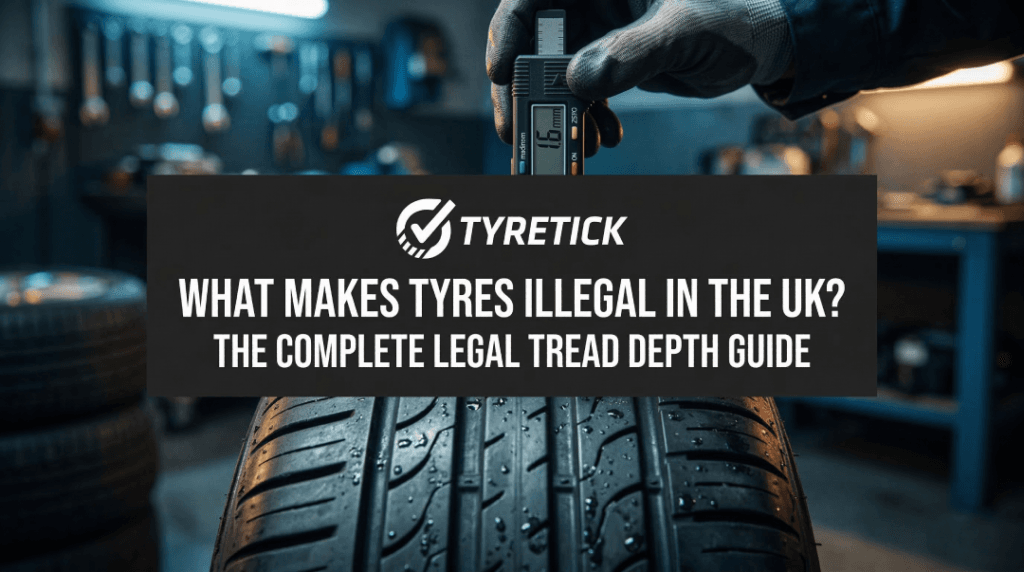
1.6mm.
That’s the number. The legal tyre tread depth in the UK.
Go below it? You’re breaking the law. Per tyre.
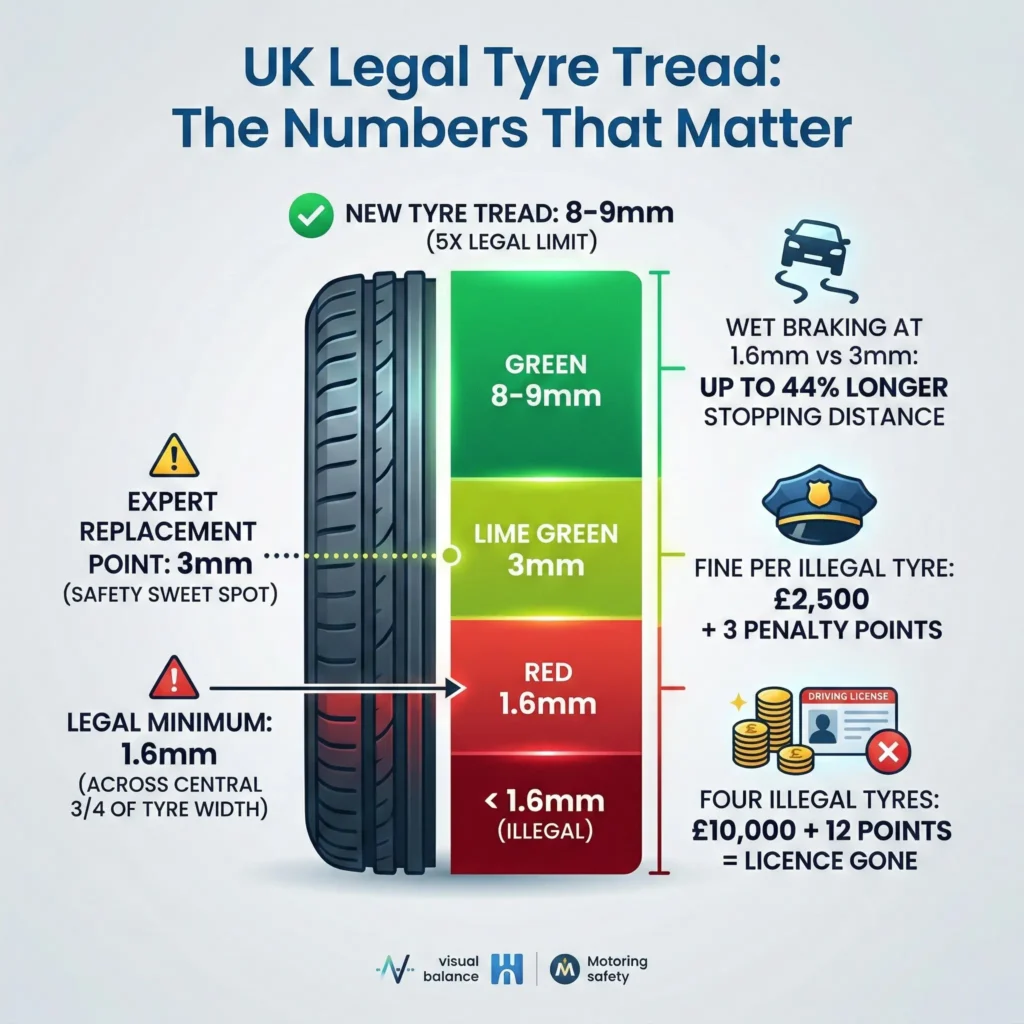
And the fines are brutal. Up to £2,500 and 3 penalty points. Per illegal tyre.
Four bald tyres? That’s £10,000 and 12 points. Goodbye licence. If you need emergency tyre replacement in London, don’t risk it.
Here’s everything you need to know about legal tyre tread in the UK.
Legal Tyre Tread Depth UK: The Exact Numbers
The minimum legal tread depth for cars and vans in the UK is 1.6mm. Simple.
But there’s a catch most drivers miss.
That 1.6mm must be across the central three-quarters of the tyre’s width. And around the entire circumference. Not just one spot.
So if one groove reads 2mm but another reads 1.4mm? Illegal.
Tread Depth Requirements by Vehicle Type
Different vehicles have different rules:
| Vehicle Type | Minimum Tread Depth | Measurement Area |
| Cars & vans (under 3,500kg) | 1.6mm | Central 3/4, full circumference |
| HGVs & buses (over 3,500kg) | 1.0mm | Central 3/4, full circumference |
| Motorcycles (over 50cc) | 1.0mm | 3/4 of tread width |
| Motorcycles (under 50cc) | Visible original tread | Entire tread pattern |
Most London drivers need to worry about the 1.6mm rule. That covers your car, your van, your SUV.
New Tyre Tread Depth vs Legal Minimum
Brand new tyres come with about 8-9mm of tread. That’s roughly five times the legal minimum.
Here’s how tread depth affects your safety:
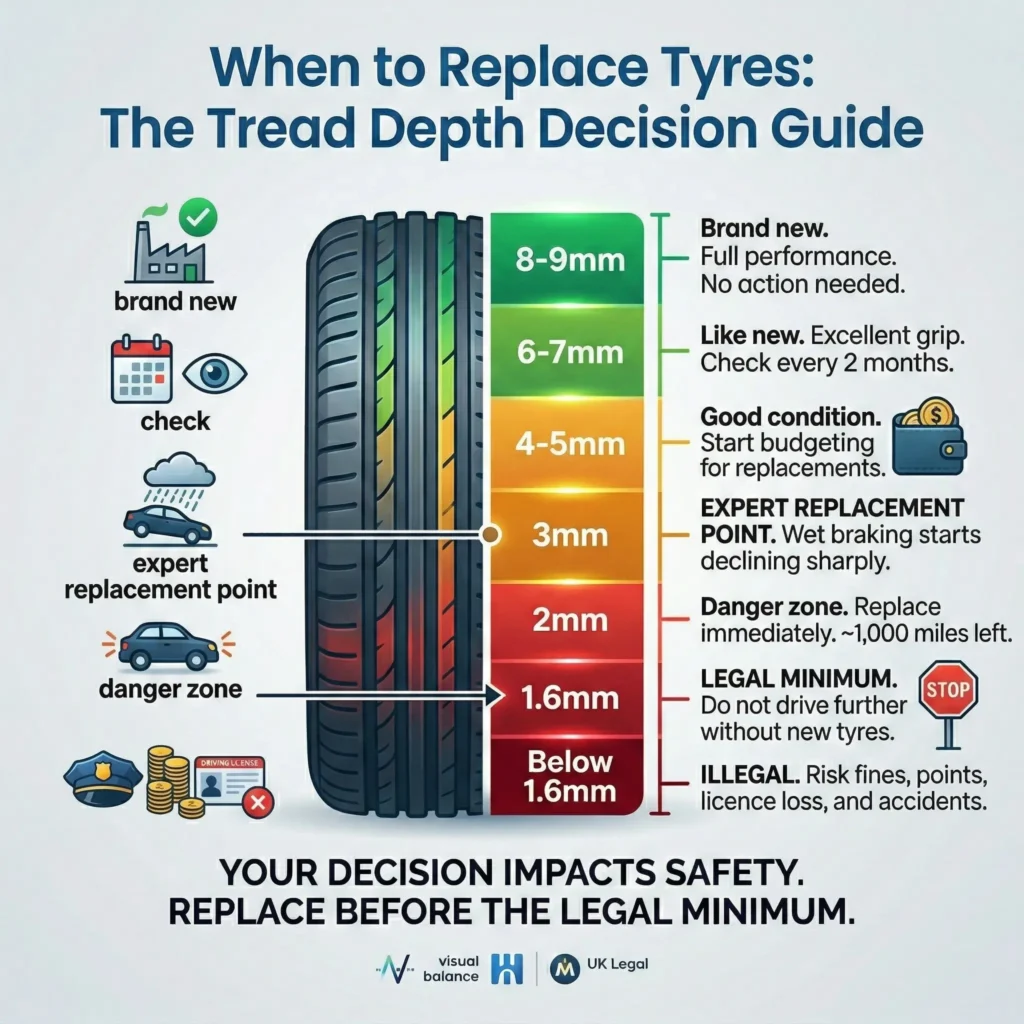
| Tread Depth | Status | Wet Braking Impact | Action Needed |
| 8-9mm | New tyre | Optimal performance | None |
| 5-6mm | Good condition | Near-optimal | Monitor regularly |
| 3-4mm | Approaching worn | Braking distance increases 25-30% | Plan replacement |
| 2mm | Close to limit | Significantly reduced grip | Replace soon |
| 1.6mm | Legal minimum | Dangerous in wet conditions | Replace immediately |
| Below 1.6mm | ILLEGAL | Extremely dangerous | Do not drive |
Notice that 3mm mark? That’s where experts recommend replacement. The AA, RAC, and most premium tyre brands like Michelin all agree. Don’t wait until 1.6mm.
6 Things That Make Tyres Illegal in the UK
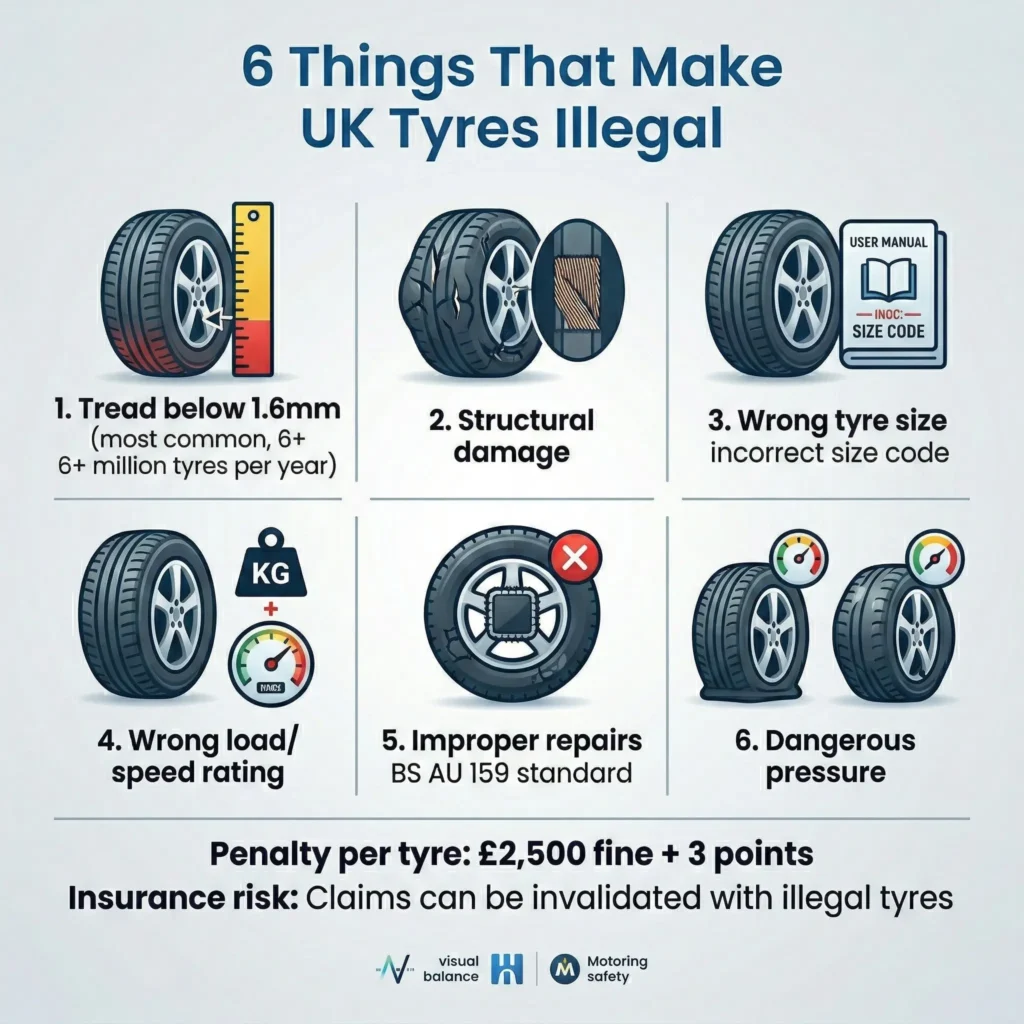
Tread depth isn’t the only thing. There are six main reasons tyres become illegal.
1. Tread Depth Below 1.6mm
The most common reason. Over 6 million tyres in the UK are found with illegal tread depth every year, according to industry data.
Your tread wears gradually. You won’t notice it day to day. But it adds up.
2. Visible Structural Damage
Cuts, bulges, cracks, or exposed cords make tyres illegal instantly. No tread depth matters if the structure is compromised.
Check for:
- Bulges or lumps on sidewalls (internal damage)
- Deep cuts exceeding 25mm or 10% of tyre width
- Exposed ply or cord material
- Cracks in the rubber (age-related)
Spotted any of these? Book a mobile tyre fitting and get it sorted fast.
3. Wrong Tyre Size or Type
Your vehicle has a specific tyre size listed in the manual. Fitting the wrong size? Illegal.
Mixing radial and cross-ply tyres on the same axle is also banned. It causes uneven handling and wear.
4. Incorrect Load or Speed Rating
Every tyre has a load index and speed rating on the sidewall. Use tyres rated below your vehicle’s requirements? That’s illegal too.
This matters especially for 4×4 and SUV tyres and van tyres that carry heavier loads.
5. Badly Repaired Tyres
Puncture repairs must follow British Standard BS AU 159. Only tread area punctures can be repaired. Sidewall repairs? Never legal.
If you’ve got a punctured tyre, get it inspected by a professional before assuming it’s repairable.
6. Dangerously Low Tyre Pressure
Severely under-inflated or over-inflated tyres can be classed as dangerous. Police can issue penalties for this too.
Low pressure causes uneven wear, higher fuel consumption, and blowout risk. Check your pressures fortnightly.
How Do You Measure Tyre Tread Depth? 3 Simple Methods
You don’t need a mechanic for this. Takes two minutes.
The 20p Coin Test (Quick Check)
Grab a 20p coin. Insert it into the main tread grooves.
Can’t see the outer band of the coin? You’re above the legal limit. Good.
Can see the outer band? Your tread is approaching 1.6mm. Get it checked properly.
Important: This test gives a rough guide only. It won’t tell you exact millimetres.
Using a Tread Depth Gauge (Most Accurate)
A proper tread depth gauge costs £3-£10. Best investment for your safety.
How to use it:
- Push the probe into the deepest part of the main tread groove
- Press the shoulders flat against the tread surface
- Read the measurement in millimetres
- Repeat at multiple points around the tyre
- Check across the central three-quarters of the width
Do this on all four tyres. Plus the spare.
Built-In Tread Wear Indicators
Every tyre has these. Small raised bars (about 5mm wide) sitting in the base of the main grooves.
When the tread surface is level with these bars, you’ve reached 1.6mm. Replace immediately.
| Method | Cost | Accuracy | Best For |
| 20p coin test | Free | Approximate | Quick monthly checks |
| Tread depth gauge | £3-£10 | Exact to 0.1mm | Accurate home measurement |
| Tread wear indicators | Free (built-in) | Shows legal limit only | Visual quick check |
| Professional check | Usually free | Most reliable | Annual or pre-MOT check |
Penalties for Driving with Illegal Tyres in the UK
The fines are steep. Deliberately so.
Per illegal tyre:
- Up to £2,500 fine
- 3 penalty points on your licence
Four illegal tyres:
- Up to £10,000 total fine
- 12 penalty points (automatic disqualification)
But the financial hit goes further.
Insurance Implications
Have an accident with illegal tyres? Your insurer can refuse to pay out. Entirely.
That means you’re personally liable for:
- All repair costs to your vehicle
- Repair costs to other vehicles
- Medical expenses
- Third-party claims
One set of worn tyres could cost you thousands. Real thousands. Not just the fine.
Don’t take that risk. Mobile tyre fitting across London means you can get legal tyres fitted at your home or office. Fast.
When Should You Actually Replace Your Tyres?
The legal limit is 1.6mm. But should you wait that long?
No.
Here’s why. At 1.6mm, your wet braking distance from 50mph is roughly 38 metres. At 3mm, it’s about 26 metres. That’s 12 metres of difference. Three car lengths.
The sweet spot? Replace at 3mm. You’ll stay safe and avoid the penalty zone completely.
Seasonal Considerations for London Drivers
London gets about 106 rainy days per year. That’s a lot of wet road.
If your tyres are already at 2-3mm heading into autumn? Replace them. Don’t gamble with wet grip. Consider all-season tyres for year-round London driving.
MOT and Illegal Tyres: What Inspectors Check
Over 2 million MOT failures per year happen because of tyre defects. That’s a big number.
MOT inspectors check every tyre for:
- Tread depth (must be at least 1.6mm across the central 3/4)
- Visible damage (cuts, bulges, cracks, exposed cords)
- Correct size and type for the vehicle
- Matching tyres on each axle
- Proper load and speed ratings
Even if a tyre technically passes at 1.7mm, the inspector may issue an advisory. That means it’ll likely fail next time.
Smart move? Get your tyres checked before your MOT. A home tyre fitting service saves you the hassle of a retest.
Frequently Asked Questions
How Long Will 2mm Tyre Tread Last?
Not long. Roughly.
According to the AA, you can expect around 1,000 miles from 2mm of tread. Maybe less in London.
City driving wears tyres faster than motorway cruising. More braking, more turning, more stop-start.
At 2mm, you’re already well below the recommended 3mm replacement point. And you’re only 0.4mm from being illegal.
Don’t wait. Book 24/7 mobile tyre fitting and get sorted.
How Long Will 5mm Tyre Tread Last?
Much longer. You’ve got breathing room.
The AA estimates roughly 20,000 miles from 5mm of tread. But this varies massively.
Factors that change it:
- Driving style (aggressive braking shortens life)
- Road type (city roads wear tyres faster)
- Tyre quality (premium brands like Continental and Bridgestone last longer)
- Tyre pressure (incorrect pressure accelerates wear)
- Alignment (misalignment causes uneven wear)
At 5mm, check monthly. You’ve got time, but keep monitoring. Mobile wheel balancing helps tyres wear evenly and last longer.
Can I Drive With a Punctured Tyre?
Short answer: probably not safely. Check our full guide on whether you can drive with a punctured tyre. But if pressure drops below 20 PSI, stop immediately.
Do All Four Tyres Need the Same Tread Depth?
Not legally. Each tyre is assessed individually.
But practically? Big differences between front and rear tread depth affect handling. Ideally, keep them within 2mm of each other.
Stay Legal, Stay Safe: Your Tyre Checklist
Illegal tyres aren’t just a legal problem. They’re a safety problem. Every day.
Here’s your action plan:
- Check tread depth monthly (20p test or gauge)
- Replace at 3mm, not 1.6mm
- Inspect for cuts, bulges, and cracks regularly
- Maintain correct tyre pressure fortnightly
- Ensure correct tyre size and type for your vehicle
- Get professional checks before MOT
Two minutes of checking can save you £10,000 in fines. Or worse.
Need new tyres now? Contact Tyretick for 24/7 mobile tyre fitting anywhere in London. We come to you. Fast. No excuses left for illegal tyres.