BANG.
That’s the sound. Loud. Violent. Terrifying.
Your steering wheel jerks left. The car pulls hard. Something’s very wrong.
Tyre blowout.
It happens fast. And if you don’t know how to react, the consequences can be devastating. But here’s the good news. Most blowouts are preventable. And if one does happen, staying calm keeps you alive.
Need emergency tyre replacement right now? Tyretick’s 24/7 mobile tyre fitting reaches you anywhere in London. Fast.
What Actually Causes a Tyre Blowout?
Blowouts don’t just happen. Something causes them. Always.
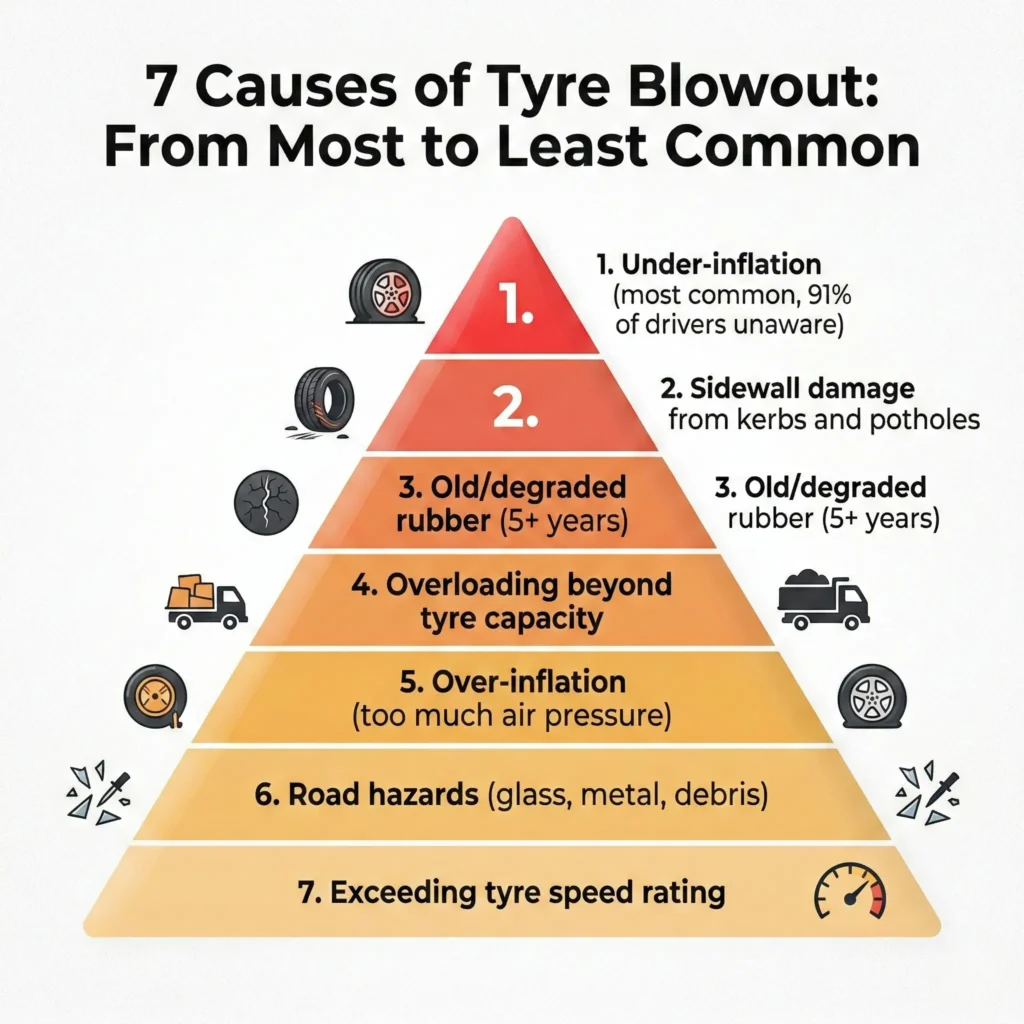
And the number one cause? Under-inflated tyres. By a huge margin.
According to Halfords, 91% of drivers don’t even realise that under-inflation is the leading cause of tyre blowouts. That’s a staggering number.
Under-Inflation: The Silent Killer
Here’s what happens when your tyre pressure is too low.
The tyre flexes more than it should. More rubber touches the road. Friction increases. Heat builds up. The sidewall weakens.
And then? Boom.
At motorway speeds, an under-inflated tyre can overheat so fast that the rubber literally tears apart. The tyre doesn’t slowly deflate. It explodes.
Over-Inflation: Just as Dangerous
Too much air makes the tyre rigid. Stiff. Less able to absorb impact.
Hit a pothole with an over-inflated tyre and the force goes straight through the rubber instead of being absorbed. Result? A split. A burst. A blowout.
Other Common Causes of Tyre Burst While Driving
| Cause | What Happens | Risk Level | Prevention |
| Under-inflation | Excess heat builds in sidewall | Very High | Monthly pressure checks |
| Over-inflation | Tyre too rigid, can’t absorb impact | High | Check manufacturer PSI |
| Sidewall damage | Structural weakness leads to burst | Very High | Visual inspection fortnightly |
| Overloading | Excess weight stresses rubber | High | Check vehicle load rating |
| Potholes and debris | Impact fractures internal structure | Medium | Avoid where possible, inspect after |
| Old/worn tyres | Rubber degrades, loses flexibility | High | Replace after 5-6 years |
| Exceeding speed rating | Tyre overheats beyond design limits | Medium-High | Check speed rating on sidewall |
Every single one of these is preventable. That’s the point.
Sidewall Damage: Why It’s the Most Dangerous Tyre Problem
Sidewall damage can’t be repaired. Full stop.
Under UK tyre repair standards (BS AU 159), repairs to the sidewall are not permitted. A mechanic won’t fix it. They can’t. The structure is too compromised.
And driving on a damaged sidewall? That’s a blowout waiting to happen.
Types of Sidewall Damage to Watch For
| Damage Type | What It Looks Like | Severity | Action Required |
| Bulge/bubble | Visible swelling on sidewall surface | Critical | Replace immediately |
| Deep cut | Open slit exposing inner cords | Critical | Replace immediately |
| Cracks | Small lines in rubber surface | Serious | Professional inspection |
| Scuff/graze | Surface rubber worn from kerbing | Minor to moderate | Monitor closely |
What Causes Sidewall Damage?
- Kerbing while parking (the most common cause)
- Hitting potholes at speed
- Driving over sharp debris (glass, metal)
- Under-inflation causing excess sidewall flex
- Over-inflation making rubber brittle
- Age and UV exposure causing cracks
TyreSafe reported that 190 people were killed or seriously injured in 2023 due to defective tyres. A 29% increase from 2022. Many of those incidents trace back to sidewall damage that went unnoticed.
Spotted a bulge or cut? Don’t drive on it. Book home tyre fitting and we’ll bring the replacement to your door.
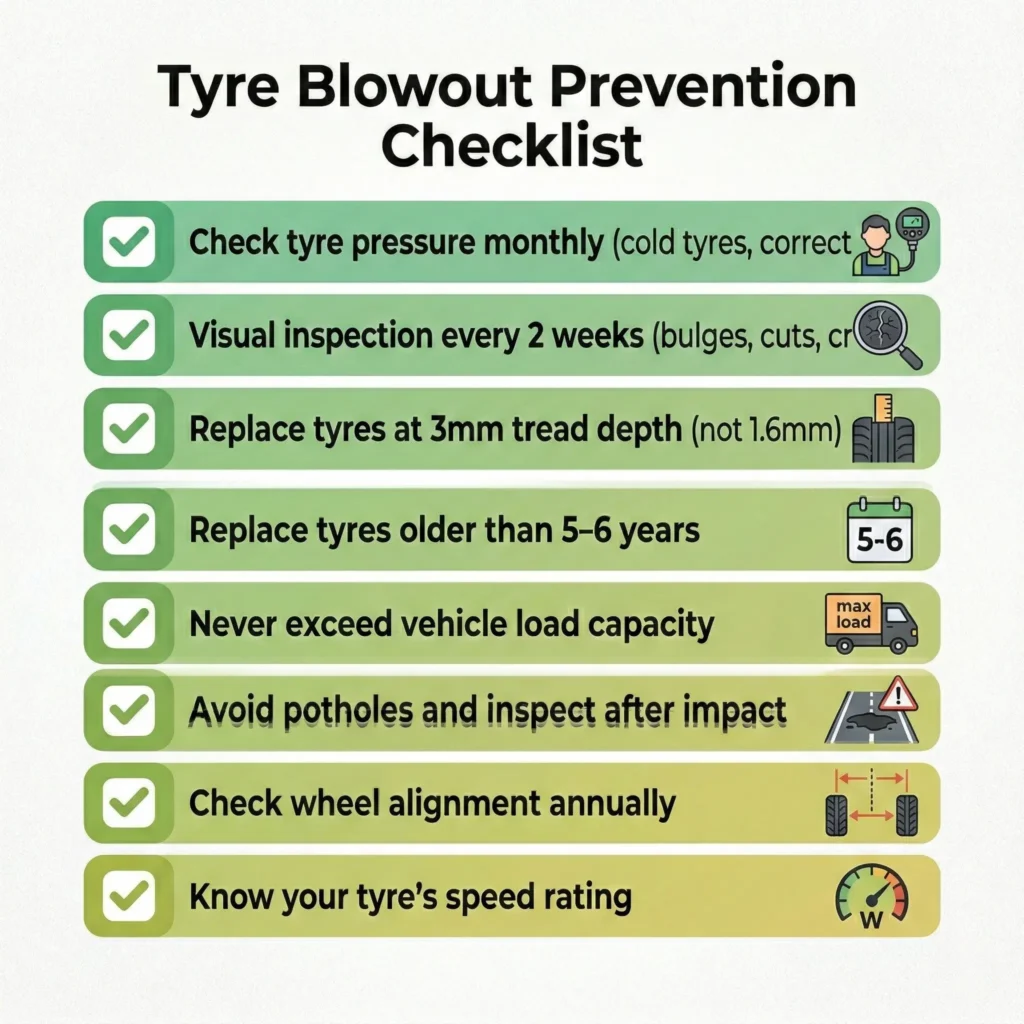
How to Avoid Tyre Burst: 8 Prevention Steps That Actually Work
Prevention beats reaction. Every time.
Here’s what keeps your tyres intact.
Check Tyre Pressure Monthly
This is the single most important thing you can do. No debate.
Check pressure when tyres are cold. Before you drive. Not after. Use a reliable gauge or visit a petrol station with a digital pump.
Your correct PSI is in the owner’s manual, on the sticker inside the driver’s door, or inside the fuel cap. Different for front and rear. Different when fully loaded.
Inspect Tyres Visually Every Fortnight
Walk around your car. Look at each tyre. Both sides if you can.
What are you looking for?
- Bulges or bubbles on the sidewall
- Cuts, cracks, or exposed cords
- Nails, screws, or debris stuck in the tread
- Uneven wear patterns
- Low tread depth (use the 20p coin test)
Takes two minutes. Could save your life.
Replace Old or Worn Tyres Before They Fail
Tyres degrade with age. Rubber hardens. Flexibility drops. Replace every 5–6 years. Maximum 10 years regardless of condition. And when tread reaches 3mm, swap them. Don’t push to the 1.6mm legal limit. Choose quality brands like Bridgestone or Goodyear tyres for longer-lasting, safer rubber.
More Prevention Steps
- Don’t overload your vehicle beyond its rated capacity
- Avoid potholes where safe to do so (and inspect tyres after hitting one)
- Drive smoothly, avoid harsh braking and fast cornering
- Never exceed your tyre’s speed rating
- Get wheel alignment checked annually or after hitting a bad pothole
Our mobile wheel balancing service catches alignment issues before they cause real damage.
How to Control the Car If a Tyre Bursts: Step-by-Step Survival Guide
This section could save your life. Read it carefully.
A blowout at 70mph on the motorway is terrifying. But the actions you take in the first 3–5 seconds determine everything.
The Golden Rules When a Tyre Blows
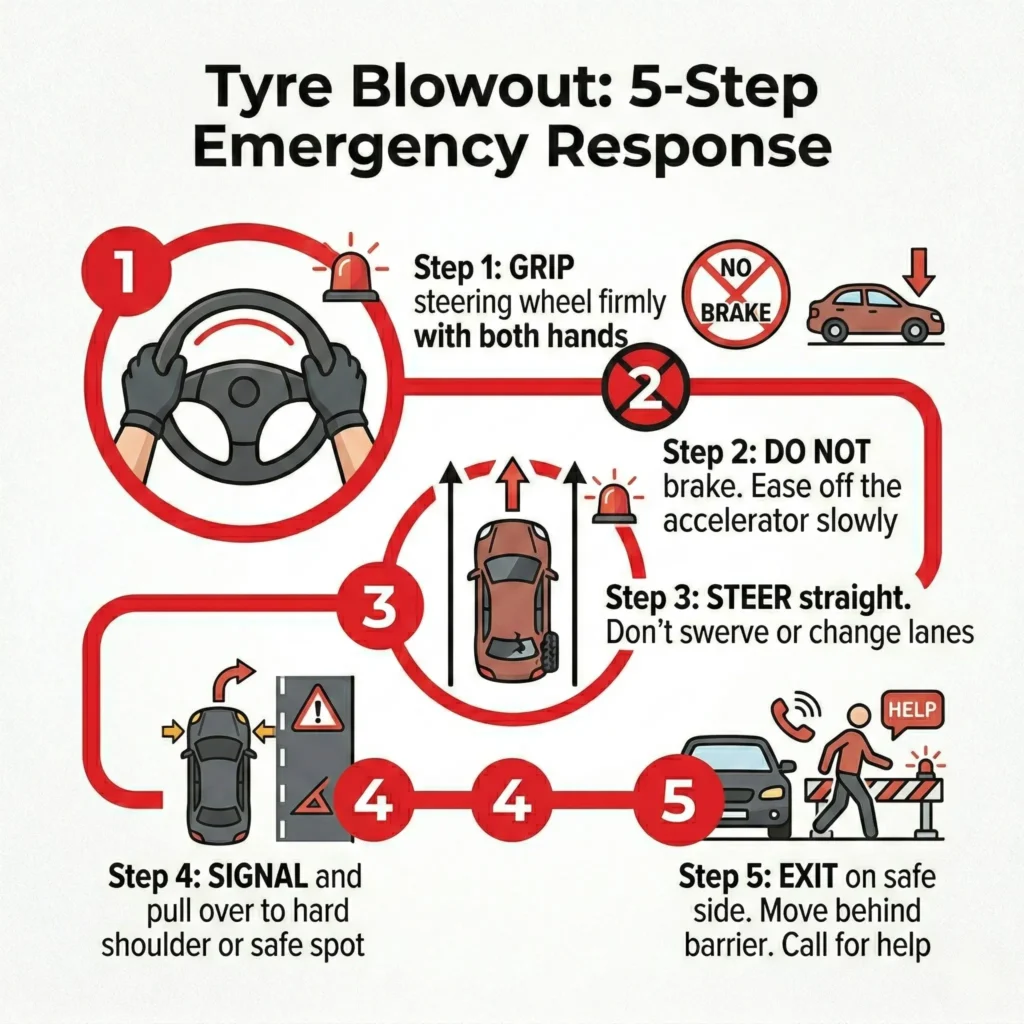
Rule one. DO NOT slam the brakes.
This is the hardest part. Your instinct screams brake. Don’t. Hard braking after a blowout causes the car to swerve violently, spin, or even flip. Especially at speed.
Instead, do this.
Step 1: Grip the Steering Wheel Firmly
Both hands. 10 and 2 position. Hold it straight. The car will try to pull to the side of the blown tyre. Fight it gently. Don’t overcorrect.
Step 2: Ease Off the Accelerator
Slowly. Gradually. Let the car decelerate naturally. Some experts even recommend a brief press of the accelerator to stabilise the car before easing off. Sounds strange. Works.
Step 3: Steer Straight and Stay in Your Lane
Don’t swerve. Don’t change lanes. Don’t panic. Keep the car going straight until speed drops below 30mph.
Step 4: Signal and Pull Over Safely
Hazard lights on. Gently steer to the hard shoulder or nearest safe spot. Brake lightly once you’re at low speed.
Step 5: Get Out and Get Safe
Exit the car on the side away from traffic. Move behind the barrier if you’re on a motorway. Never attempt to change a tyre on a live carriageway.
Front Tyre Blowout vs Rear Tyre Blowout
| Factor | Front Tyre Blowout | Rear Tyre Blowout |
| Steering effect | Strong pull to one side | Car sways/fishtails |
| Control difficulty | Harder to steer straight | Harder to stabilise rear |
| Sound | Loud bang from front | Muffled bang from behind |
| Key response | Hold wheel firm, counter-steer gently | Ease off gas, steer straight, avoid braking |
| Most dangerous at | Motorway speeds (steering loss) | Motorway speeds (fishtailing risk) |
Both are dangerous. But a front blowout gives you slightly more warning because you feel it instantly through the steering wheel. A rear blowout can catch you off guard.
What to Do After a Tyre Blowout
You’re pulled over. Safe. Heart racing. Now what?
Assess the Damage
The blown tyre is destroyed. But check the others too. The sudden stress of a blowout can affect surrounding tyres, suspension, and even the wheel rim.
Look for exposed wires and sharp edges on the blown tyre. Be careful.
Call for Professional Help
Don’t try to change a tyre on a busy motorway. It’s one of the most dangerous roadside activities there is.
Call Tyretick. Our emergency tyre fitting service operates 24/7 across London. We’ll come to your exact location with the right tyre. Fitted on the spot.
Had a puncture instead of a blowout? That might be repairable. A blowout never is. The tyre needs full replacement.
Can You Prevent Every Tyre Blowout?
Honestly? No.
A sharp piece of metal on the road at 70mph can blow out even a brand new, perfectly inflated tyre. Bad luck exists.
But you can prevent 90%+ of blowouts with basic maintenance.
- Monthly pressure checks (takes 2 minutes)
- Fortnightly visual inspections (takes 2 minutes)
- Replacing tyres at 3mm tread depth
- Replacing tyres over 5–6 years old
- Choosing quality brands over cheap unknowns
Want reliable rubber? Browse Pirelli tyres or Continental tyres from Tyretick. Fitted at your home, office, or roadside.
Frequently Asked Questions
What does a tyre blowout sound like?
A loud bang or explosion. Like a gunshot. Followed by a flapping or thumping sound as the destroyed rubber hits the road and wheel arch.
Can a tyre blowout cause an accident?
Yes. Absolutely. Loss of vehicle control after a blowout is one of the most dangerous situations on UK roads. That’s why knowing the emergency response steps matters so much.
How fast does a blowout happen?
Instantly. One second your tyre is fine. The next it’s destroyed. There’s no gradual deflation like a slow puncture. The air escapes in a fraction of a second.
Are blowouts more common in summer?
Yes. Hot road surfaces combined with already warm tyres create more heat buildup. Summer is peak blowout season in the UK, especially during heatwaves.
Should I repair or replace a tyre after a blowout?
Replace. Always. A blowout destroys the tyre’s internal structure beyond repair. Read more in our guide on how to change a punctured tyre.
What does a tyre blowout sound like?
Stay Ahead of the Bang. Look After Your Tyres.
A tyre blowout is sudden, violent, and terrifying. But it’s rarely random.
Under-inflation. Sidewall damage. Old rubber. Overloading. These are the real causes. And they’re all preventable with basic checks that take minutes.
Check your pressure monthly. Inspect your tyres fortnightly. Replace them before they fail.
And if the worst happens? Grip the wheel. Ease off the gas. Steer straight. Pull over safely.
Need new tyres fitted fast? Contact Tyretick for mobile tyre fitting across London. 24/7. All major brands. We come to you. No hidden costs.
Your tyres. Your safety. Don’t leave it to chance.