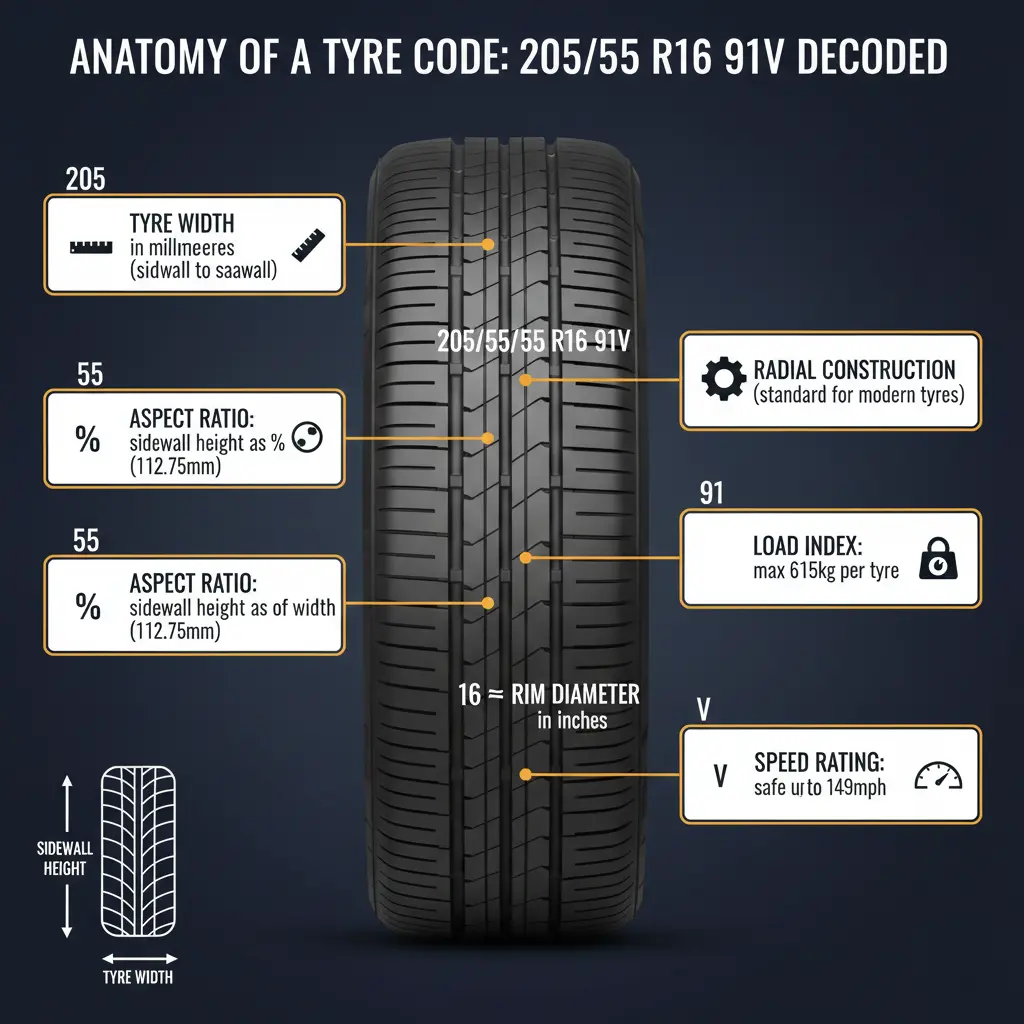
205/55 R16 91V.
That string of numbers lives on your tyre right now. And most drivers have zero idea what it means.
Tyre sidewall markings tell you the width, height, construction, rim size, load capacity and maximum speed of your tyre. Get them wrong when buying replacements? You risk your safety, your insurance, and a £2,500 fine per tyre.
Here’s exactly what every number and letter means. And if you need new tyres fitted to your door, our mobile tyre fitting service covers the whole UK.
Spoiler: it’s simpler than it looks.
Part 1: Breaking Down the Main Tyre Code
Every tyre sold in the UK carries one critical code. It’s printed on the sidewall in raised letters.
This code holds six pieces of information. Miss one and you could fit the wrong tyre entirely.
Tyre Width (First Three Digits)
The first number is the tyre’s width in millimetres. Measured from one sidewall edge to the other.
In 205/55 R16, that’s 205mm. Simple.
Common widths for UK cars range from 155mm to 275mm. Wider tyres give more grip. But they also increase rolling resistance and fuel consumption.
Why Width Matters for Your Car
Fitting tyres that are too wide can rub against wheel arches. Too narrow? Reduced grip and handling.
Always check your vehicle handbook. Or look at your current tyres before ordering. Our home tyre fitting team can verify your size on arrival.
Aspect Ratio (The Number After the Slash)
The second number is the aspect ratio. It’s the sidewall height as a percentage of the width.
So 55 means the sidewall is 55% of 205mm. That’s 112.75mm tall.
Low Profile vs High Profile
Lower numbers mean shorter sidewalls. Think sporty cars with 35 or 40 profiles.
Higher numbers like 65 or 70 give a softer ride. But less sharp handling.
Want better cornering response? Check out our performance tyres range for options.
Construction Type (The Letter R)
The R stands for Radial. Nearly every modern tyre uses radial construction.
Radial tyres have cord plies arranged at 90 degrees to the direction of travel. This gives better grip, longer life and lower fuel use.
You might rarely see B (bias-ply) or D (diagonal). These are for specialist vehicles only. Don’t mix radial and cross-ply tyres. Ever.
Rim Diameter (The Number After R)
This is the wheel size in inches. In our example, 16 means a 16-inch rim.
Common UK rim sizes range from 14 to 20 inches. Larger rims usually mean lower profile tyres.
| Tyre Size | Width (mm) | Aspect Ratio | Rim (inches) | Common Vehicles |
| 185/65 R15 | 185 | 65 | 15 | Ford Fiesta, VW Polo |
| 195/65 R15 | 195 | 65 | 15 | VW Golf, Ford Focus |
| 205/55 R16 | 205 | 55 | 16 | BMW 3 Series, Audi A3 |
| 225/45 R17 | 225 | 45 | 17 | Audi A4, Mercedes C-Class |
| 225/40 R18 | 225 | 40 | 18 | BMW 4 Series, VW Arteon |
| 235/35 R19 | 235 | 35 | 19 | Audi RS3, Mercedes AMG |
| 255/50 R19 | 255 | 50 | 19 | Range Rover, BMW X5 |
Part 2: Tyre Load Rating Explained
The load index is the two or three digit number after the rim size. It tells you how much weight each tyre can handle.
Get this wrong, and you’re asking for trouble. Overloaded tyres overheat. They wear faster. They can blow out.
How the Load Index System Works
Each number corresponds to a weight in kilograms. It’s not a direct measurement. You need to look it up on a chart.
A load index of 91 means 615kg per tyre. Four tyres? That’s 2,460kg total capacity.
Your vehicle’s handbook specifies the minimum load index. Never go below it.
Tyre Load Index Chart (Common UK Values)
| Load Index | Max Weight (kg) | Load Index | Max Weight (kg) |
| 71 | 345 | 88 | 560 |
| 73 | 365 | 90 | 600 |
| 75 | 387 | 91 | 615 |
| 77 | 412 | 93 | 650 |
| 79 | 437 | 95 | 690 |
| 80 | 450 | 97 | 730 |
| 82 | 475 | 99 | 775 |
| 84 | 500 | 100 | 800 |
| 85 | 515 | 102 | 850 |
| 86 | 530 | 104 | 900 |
| 87 | 545 | 106 | 950 |
Why Load Rating Matters More Than You Think
UK law requires tyres to match your vehicle’s specified load index. Fitting lower-rated tyres is dangerous.
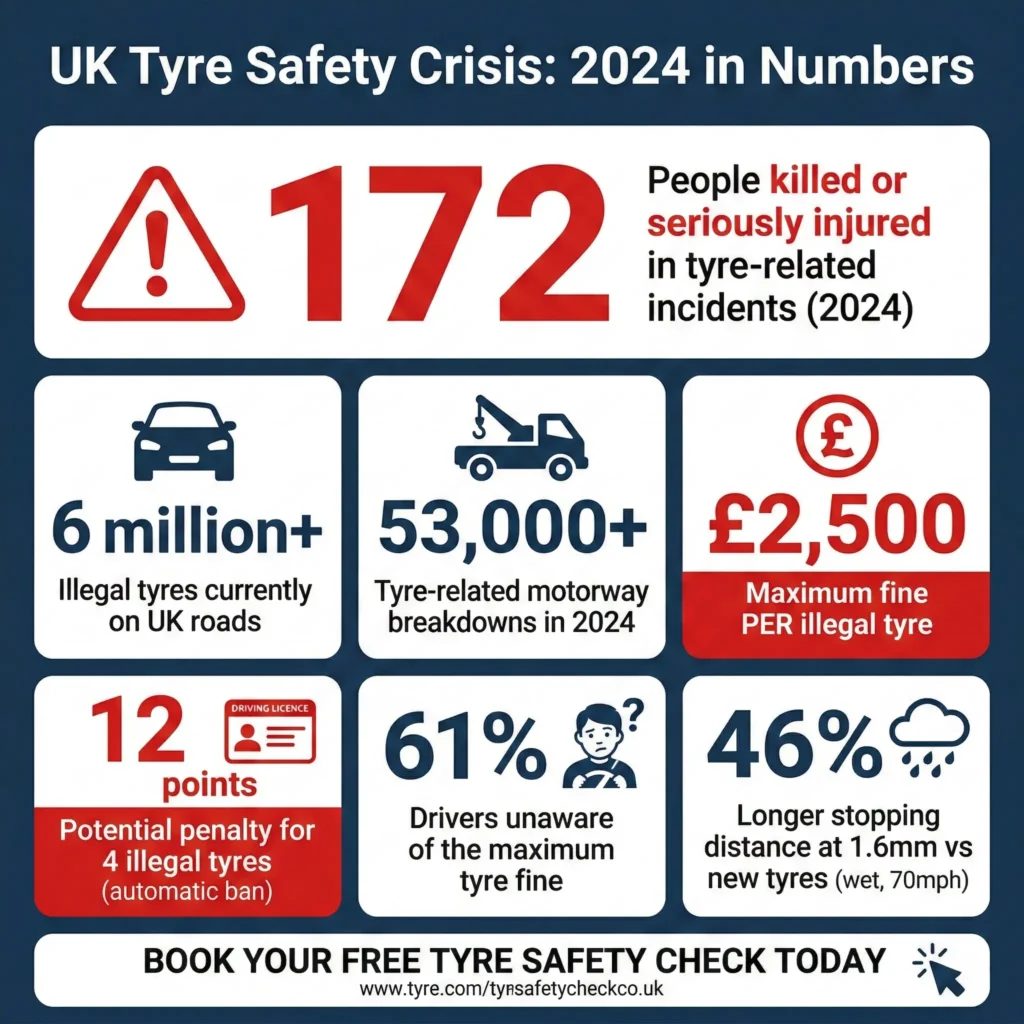
172 people were killed or seriously injured in tyre-related incidents across the UK in 2024. Overloading was a contributing factor in many cases.
Think about it. Your family car with four passengers and luggage for holiday. That weight adds up fast.
XL and Reinforced Tyres
See XL on your tyre sidewall? It stands for Extra Load. Not extra large.
XL tyres have reinforced construction. They handle higher pressures and heavier vehicles. SUVs, performance cars and electric vehicles often require them.
Electric vehicles are heavier due to battery packs. That’s why EV tyres often carry the XL or newer HL (Heavy Load) marking.
HL Tyres: The New Standard for EVs
HL stands for Heavy Load. Introduced in 2021 for electric and hybrid vehicles.
These carry even more weight than XL tyres. Same physical size. Stronger internal construction.
If your car came with HL tyres, replace them with HL tyres. No exceptions.
Part 3: Tyre Speed Rating Decoded
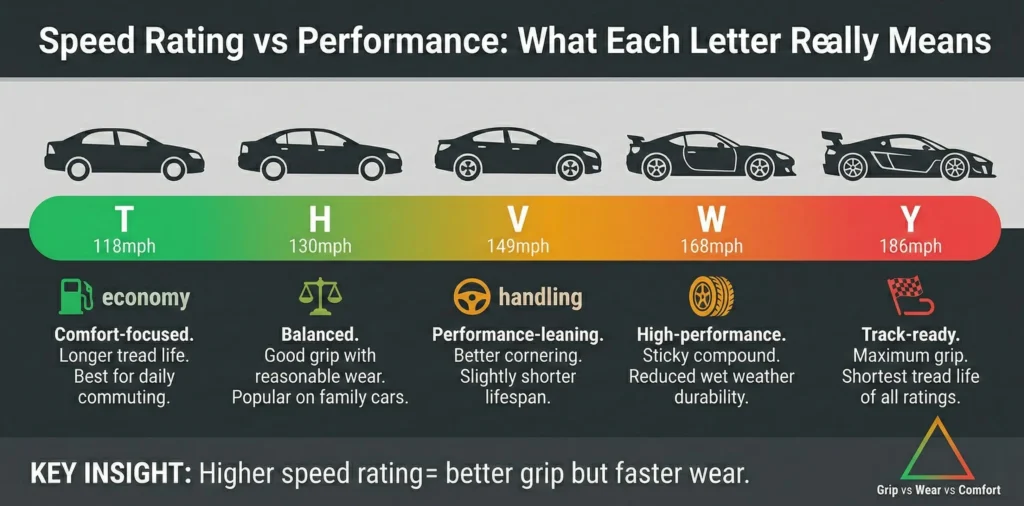
The speed rating is the final letter in your tyre code. It tells you the maximum sustained speed the tyre can handle safely.
But it’s not just about speed. It also affects grip, handling and ride comfort.
How Speed Ratings Are Tested
Manufacturers test tyres in labs. They run at increasing speeds in 10km/h steps, 10 minutes at each level.
The rating shows the highest speed the tyre survived without failure. Under load. At correct pressure.
Full Speed Rating Chart
| Rating | Max Speed (mph) | Max Speed (km/h) | Typical Use |
| N | 87 | 140 | Spare tyres |
| P | 93 | 150 | Small city cars |
| Q | 99 | 160 | Winter tyres |
| R | 106 | 170 | Light trucks |
| S | 112 | 180 | Family saloons |
| T | 118 | 190 | Family saloons, MPVs |
| U | 124 | 200 | Estate cars |
| H | 130 | 210 | Sports saloons |
| V | 149 | 240 | Sports cars |
| W | 168 | 270 | High-performance |
| Y | 186 | 300 | Supercars |
| (Y) | 186+ | 300+ | Hypercars |
Can You Change Your Speed Rating?
You can go higher. Never lower.
Fitting a V-rated tyre on a car that needs H? Perfectly fine. You get slightly better grip and handling.
Going the other way? That could void your insurance. Seriously.
The AA confirms that lower-rated tyres risk both safety and insurance coverage. If you’re unsure, our mobile tyre fitting technicians can check your requirements on-site.
The Z Rating Exception
Sometimes you’ll see ZR in the tyre code. Like 225/40 ZR18.
The Z means the tyre can handle speeds above 149mph. It’s an older classification that sits alongside the modern W and Y ratings.
If your tyre shows ZR plus a W or Y rating, both apply. The specific letter gives you the exact limit.
Winter Tyres and Speed Ratings
Here’s a useful exception. Winter tyres can legally be one speed rating lower than specified.
Most UK vehicle manufacturers allow this. But you should still check your handbook. Browse our all season tyres for year-round solutions.
Part 4: Other Tyre Sidewall Markings You Need to Know
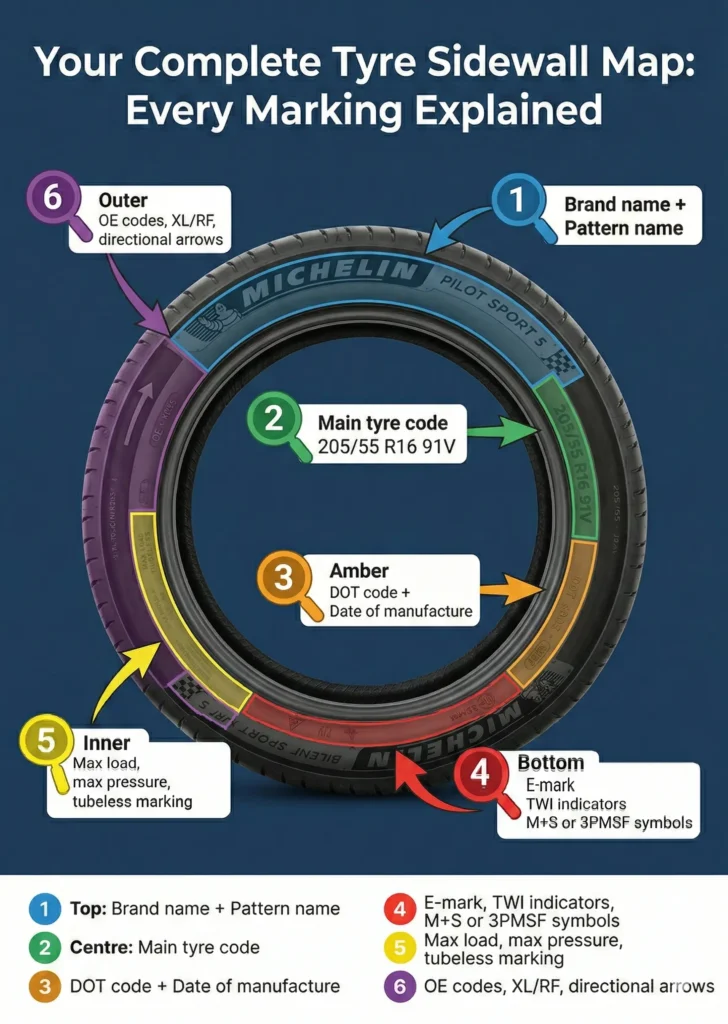
The main code is just the beginning. Your tyre sidewall is covered in additional markings. Each one means something specific.
Here’s what the rest of those letters, numbers and symbols actually tell you.
DOT Code and Manufacturing Date
Look for a code starting with DOT. The last four digits are the important bit.
First two digits = week of manufacture. Last two = year.
So 2524 means week 25 of 2024. Simple.
How Old Is Too Old?
Most manufacturers recommend replacing tyres after 10 years. Regardless of tread depth.
Rubber degrades over time. Even tyres sitting unused in a garage deteriorate.
After 5 years, get them inspected annually. After 10 years, replace them.
E-Mark (European Approval)
An E inside a circle followed by a number. This confirms the tyre meets European safety standards.
E11 means it was tested and approved in the UK. E1 is Germany. E2 is France.
Every tyre sold in the UK must carry this mark. It’s a legal requirement.
Tread Wear Indicators (TWI)
Small raised bars sit inside the tyre’s grooves. They’re your built-in warning system.
When the tread wears level with these bars, you’ve hit 1.6mm. The legal minimum in the UK.
Don’t wait that long. Braking performance drops dramatically below 3mm. If your tread looks low, book a puncture repair or inspection with us.
Quick Reference: Additional Tyre Markings
| Marking | Meaning | What to Do |
| XL / EXL / RF / REINF | Extra Load / Reinforced tyre | Replace with same type |
| HL | Heavy Load (for EVs/hybrids) | Replace with HL only |
| M+S | Mud and Snow capable | Not a full winter tyre |
| 3PMSF (snowflake symbol) | Severe snow conditions tested | Genuine winter performance |
| ROF / RFT / SSR / ZP | Run Flat Technology | Drives 50 miles after puncture |
| OUTSIDE / INSIDE | Asymmetric tyre fitting guide | Must face correct direction |
| Rotation arrow | Directional tyre | Fit on correct side of car |
| C | Commercial / Van tyre | Required for vans |
| Tubeless | No inner tube required | Standard for passenger cars |
OE (Original Equipment) Markings
Some tyres carry brand-specific codes. These mean the tyre was developed with that car manufacturer.
Common OE Codes by Manufacturer
| Code | Manufacturer | Code | Manufacturer |
| * (star) | BMW / Mini | MO | Mercedes-Benz |
| AO | Audi | MO1 | Mercedes-AMG |
| N0 / N1 / N2 | Porsche | RO1 | Audi Sport |
| VOL | Volvo | J | Jaguar |
| MGT | Maserati | T0 / T1 | Tesla |
| AMP | Aston Martin | HN | Hyundai / Kia |
You can fit non-OE tyres. But OE versions are optimised for your specific car’s handling, noise and ride.
Popular OE-approved brands include Michelin, Continental, and Pirelli. We stock them all.
Part 5: What Does 205/55 R16 Mean? (Full Worked Example)
This is the UK’s most common tyre size. Let’s break it down piece by piece so you never forget.
If you drive a VW Golf, Ford Focus, BMW 1 Series or similar, you probably have this size right now.
The Complete Breakdown
| Code Part | Value | What It Means | Real-World Impact |
| 205 | Width | 205mm tread width | Good balance of grip and economy |
| 55 | Aspect Ratio | Sidewall is 55% of 205mm (112.75mm) | Comfortable ride with decent handling |
| R | Construction | Radial tyre | Standard for all modern cars |
| 16 | Rim Diameter | Fits 16-inch wheels | Common mid-range wheel size |
| 91 | Load Index | 615kg per tyre (2,460kg total) | Handles most family cars fully loaded |
| V | Speed Rating | Safe up to 149mph (240km/h) | More than enough for UK roads |
What If Your Tyre Shows a Different Code?
Same principle. Different numbers.
A 225/45 R17 94W tyre is 225mm wide. 45% aspect ratio. Radial. 17-inch rim. 670kg load. 168mph speed rating.
Always match all six elements when buying replacements. Width. Profile. Construction. Rim. Load. Speed.
Part 6: UK Legal Requirements and Common Mistakes
Fitting the wrong tyres isn’t just risky. It’s potentially illegal. And expensive.
Here’s what UK law says about tyre markings and what catches drivers out most often.
The Legal Minimum Tread Depth
1.6mm across the central three-quarters of the tyre. Around its full circumference.
The fine? Up to £2,500 per tyre. Plus 3 penalty points each.
Four illegal tyres could mean £10,000 in fines and 12 points. That’s an automatic ban.
The 20p Coin Test
Insert a 20p coin into the main tread grooves. If you can see the outer band, your tread is below 1.6mm.
But here’s the thing. Most experts recommend replacing at 3mm. At 1.6mm, wet braking distances increase dramatically.
Common Tyre Fitting Mistakes
Mixing Speed Ratings
Don’t do it. Different speed ratings change how each tyre responds. This affects handling and stability.
If you must mix (which we don’t recommend), put the lower-rated tyres on the front axle.
Ignoring Load Index
A lower load index than specified is dangerous. Your tyres aren’t designed for the weight they’re carrying.
SUV and 4×4 tyres need higher load ratings. Always check before fitting.
Fitting Run Flats on Non-Run Flat Rims
Run flat tyres need compatible rims and a TPMS (Tyre Pressure Monitoring System).
Fitting them on standard rims without TPMS is unsafe. You won’t know when pressure drops.
UK Tyre Law Quick Reference
| Requirement | Detail | Penalty |
| Minimum tread depth | 1.6mm across central 75% width | £2,500 + 3 points per tyre |
| Correct size | Must match vehicle specification | MOT failure |
| Load rating | Must meet or exceed manufacturer spec | Insurance void risk |
| Speed rating | Must meet or exceed manufacturer spec | Insurance void risk |
| Tyre condition | No cuts, bulges or exposed cords | £2,500 + 3 points per tyre |
| Matching tyres | Same type on each axle | MOT advisory/failure |
| E-mark approval | Must carry ECE approval mark | Illegal to sell without |
Part 7: UK Tyre Safety: The Numbers That Should Worry You
Tyre safety isn’t just theory. The statistics from 2024 tell a sobering story.
Understanding your tyre markings is step one to staying safe on UK roads.
2024 UK Tyre Safety Statistics
172 people were killed or seriously injured in tyre-related crashes in 2024. That’s up from 153 the year before.
Over 6 million tyres on UK roads have illegal tread levels. Right now.
1 in 5 motorway breakdowns are caused by tyre defects. That’s over 53,000 breakdowns in 2024 alone.
And 61% of UK drivers don’t know the maximum fine for illegal tyres.
What Worn Tyres Actually Do to Stopping Distance
| Tread Depth | Braking at 70mph (Wet) | Difference vs New |
| 8mm (new) | 25.9 metres | Baseline |
| 3mm | 31.5 metres | +22% |
| 1.6mm (legal min) | 37.8 metres | +46% |
At 70mph on a wet road, worn tyres at 1.6mm need almost 12 metres more to stop than new tyres. That’s three car lengths.
Don’t risk it. If your tyres are getting low, book an emergency tyre fitting with Tyre Tick today.
Frequently Asked Questions
Quick answers to the tyre marking questions UK drivers ask most.
What does 205/55 R16 91V mean on a tyre?
205mm wide. 55% aspect ratio. Radial. 16-inch rim.
The 91 is load index (615kg per tyre). V is speed rating (149mph max).
It’s the UK’s most common tyre size. Fits Golf, Focus and similar cars.
What does XL mean on tyres?
Extra Load. Not extra large.
XL tyres have reinforced construction for heavier vehicles. They handle higher pressures and greater weight. SUVs, EVs and performance cars often need them.
If your car came with XL tyres, always replace with XL.
Can I fit a higher speed rating than recommended?
Yes. Always.
Higher is fine. Lower is dangerous and potentially illegal. A V-rated tyre works perfectly on a car that specifies H.
But never drop below your manufacturer’s minimum rating.
What’s the difference between tyre load rating and speed rating?
Load rating = maximum weight per tyre. Speed rating = maximum safe speed.
Both work together. The speed rating assumes the tyre is carrying its rated load at correct pressure.
Exceed either limit, and you risk failure. Check both before buying from our tyre brands range.
How do I find the right tyre size for my car?
Three places to check. Your current tyre sidewall. Your vehicle handbook. And the sticker inside the driver’s door frame.
All three should match. If they don’t, go with the handbook.
Or just call us. Our mobile tyre fitting technicians will verify your size before fitting.
What does the E marking mean on a tyre?
European safety approval. Required by UK law.
The E is followed by a number showing which country approved it. E11 is the UK. Without it, the tyre can’t legally be sold here.
The Bottom Line
Six numbers and letters. That’s all that stands between you and the wrong tyre.
Width. Profile. Construction. Rim. Load. Speed. Match all six and you’re sorted.
Your tyres are the only part of your car touching the road. Treat them accordingly. Need help? Book a mobile tyre fitting with Tyre Tick and we’ll come to you. 24/7.