“What size tyres do I need?”
That question stops thousands of drivers daily. It shouldn’t.
Your tyre size takes 30 seconds to find. Seriously.
We fit tyres across London every day with our mobile tyre fitting service. The first question we ask? Tyre size.
Here’s exactly how to find yours.
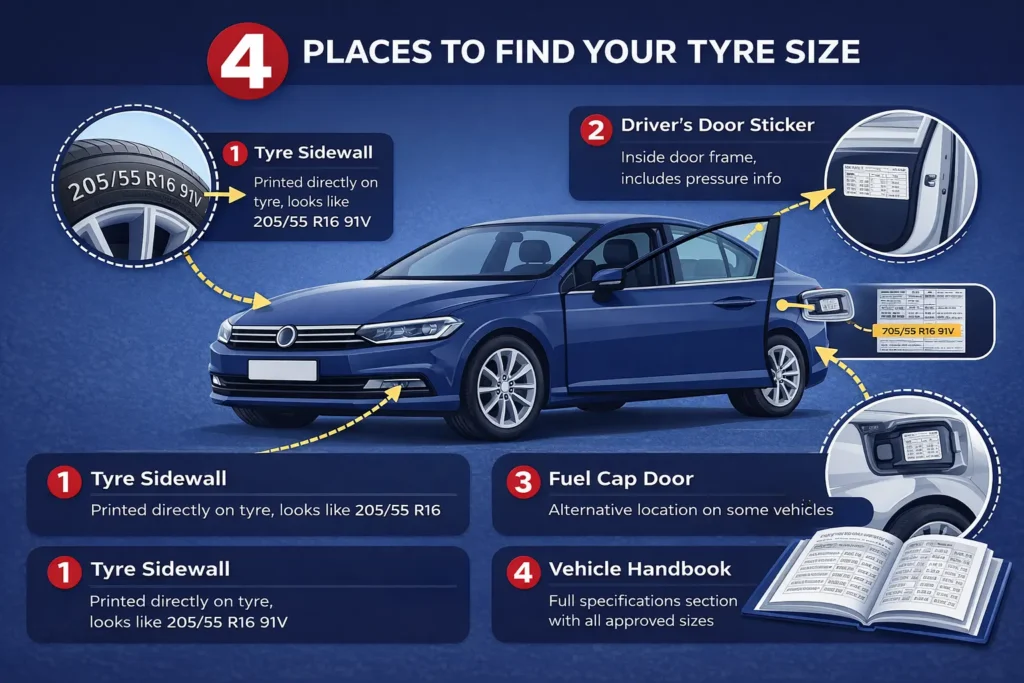
4 Ways to Find Your Tyre Size (Pick One)
You don’t need special tools. You don’t need a mechanic. You just need to know where to look.
Method 1: Check Your Tyre Sidewall (Fastest)
Walk to your car. Look at any tyre. Done.
The size is printed right on the sidewall. It looks like this: 205/55 R16 91V
That string of numbers tells you everything. Width. Height. Diameter. Load capacity. Speed rating.
Pro tip: Take a photo. You’ll need it when ordering.
Method 2: Driver’s Door Sticker
Open your driver’s door. Check the frame. See that sticker?
It lists the recommended tyre size. Plus the correct pressure. Two answers in one spot.
Can’t find it there? Check inside the fuel cap door. Some manufacturers put it there instead.
Method 3: Your Vehicle Handbook
Your car’s manual has a tyre specification section. Usually in the back. Lists all approved sizes for your model.
This matters. Some cars accept multiple tyre sizes. The handbook shows what’s safe.
Method 4: Registration Number Lookup
Got your reg? Type it into any tyre retailer’s website. The system checks DVLA data.
Returns your tyre size instantly. But double-check against your actual tyres. Previous owners sometimes fit different sizes. Our 24/7 emergency service team sees this regularly
What Do the Numbers on Tyres Mean? Complete Breakdown
Those sidewall markings look confusing. They’re not.
Let’s decode 205/55 R16 91V. Each part tells you something specific.
205: Tyre Width in Millimetres
The first three digits? Width. Measured from sidewall to sidewall. 205 means 205mm wide. Simple.
Wider tyres grip better. But they’re noisier and use more fuel. It’s a trade-off.
55: The Aspect Ratio (Sidewall Height)
This number confuses people. It’s not the height in millimetres. It’s a percentage. The sidewall height is 55% of the width. So 55% of 205mm equals about 113mm tall. Lower numbers mean sportier handling. Higher numbers mean more comfort. Most London drivers run 50-65.
R16: Construction Type and Rim Diameter
The R stands for Radial. That’s how the tyre is built internally. Almost every modern tyre is radial.
16 is your wheel diameter. In inches. This number must match your rims exactly. No exceptions
91V: Load Index and Speed Rating
91 is the load index. Each number corresponds to a maximum weight.
91 equals 615kg per tyre. Multiply by four for your car’s total capacity.
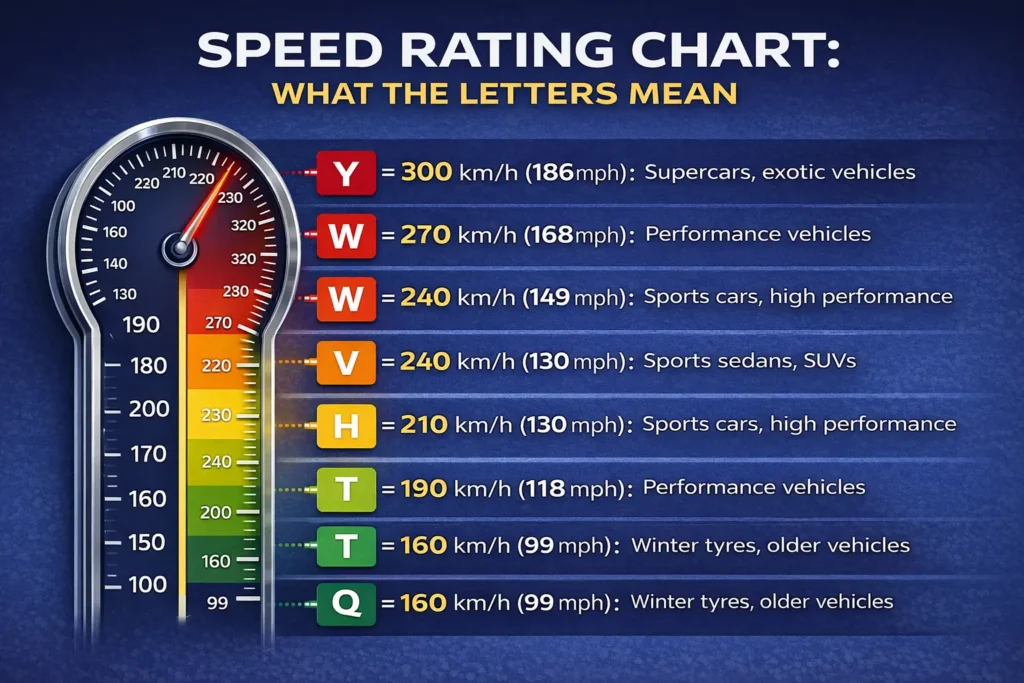
V is the speed rating. It means safe up to 149mph. More than enough for UK roads.
Important: Never fit tyres with lower ratings than your manufacturer recommends. It can invalidate your insurance. Our home tyre fitting service always matches correct specifications.
Complete tyre size breakdown:
| Marking | Meaning | Example |
| 205 | Width (mm) | 205mm from sidewall to sidewall |
| 55 | Aspect Ratio (%) | Height is 55% of width (113mm) |
| R | Construction | Radial (99% of modern tyres) |
| 16 | Rim Diameter (inches) | Fits 16-inch wheels only |
| 91 | Load Index | Max 615kg per tyre |
| V | Speed Rating | Safe up to 149mph (240km/h) |
Most Common Tyre Sizes in the UK: Where Does Yours Fit?
Not all tyre sizes are created equal. Some are everywhere. Others take longer to source.
Here’s what we see most often in London:
| Tyre Size | Common Vehicles | Availability |
| 205/55 R16 | Golf, Focus, Astra | Most common, always stocked |
| 225/45 R17 | BMW 3 Series, Audi A4 | Very common, usually available |
| 195/65 R15 | Corolla, Civic, older models | Common, good availability |
| 255/55 R18 | SUVs, Range Rover, X5 | Growing popularity, stocked |
| 175/65 R14 | Fiesta, Polo, city cars | Common, budget friendly |
Running something unusual? Contact us. We source rare sizes too.
Can I Fit Different Size Tyres on My Car?
Short answer? Sometimes. But be careful.
Wrong sizes cause problems. Real problems.
What Happens with Wrong Tyre Sizes
Your speedometer reads wrong. You think you’re doing 70. You’re actually doing 75.
Handling changes. Sometimes dangerously. The car wasn’t designed for those dimensions. Suspension wears faster. Tyres rub on wheel arches. Gearbox takes strain.
Safe Size Changes You Can Make
Stick within 3% of the original diameter. That’s the rule.
You can go slightly wider if you also reduce the profile. This keeps the overall diameter similar.
Example: 205/55 R16 can sometimes become 215/50 R16. Same diameter. Different shape.
But check your handbook first. Or ask our mobile wheel balancing team. We’ll tell you what’s safe.
Front vs Rear Tyres: Are They Always the Same Size?
Usually, yes. But not always.
Most cars run the same size on all four wheels. Makes tyre rotation easy. Keeps things simple.
But some cars are different.
Staggered Fitment: Wider Rear Tyres
BMW. Mercedes. Porsche. Many performance cars run wider tyres at the back.
Why? Better acceleration grip. More balanced handling. Looks sportier too.
Always check both axles before ordering. Our performance tyres page covers staggered fitments.
Other Tyre Markings You Should Know
Your sidewall has more than just size. Here’s what else matters:
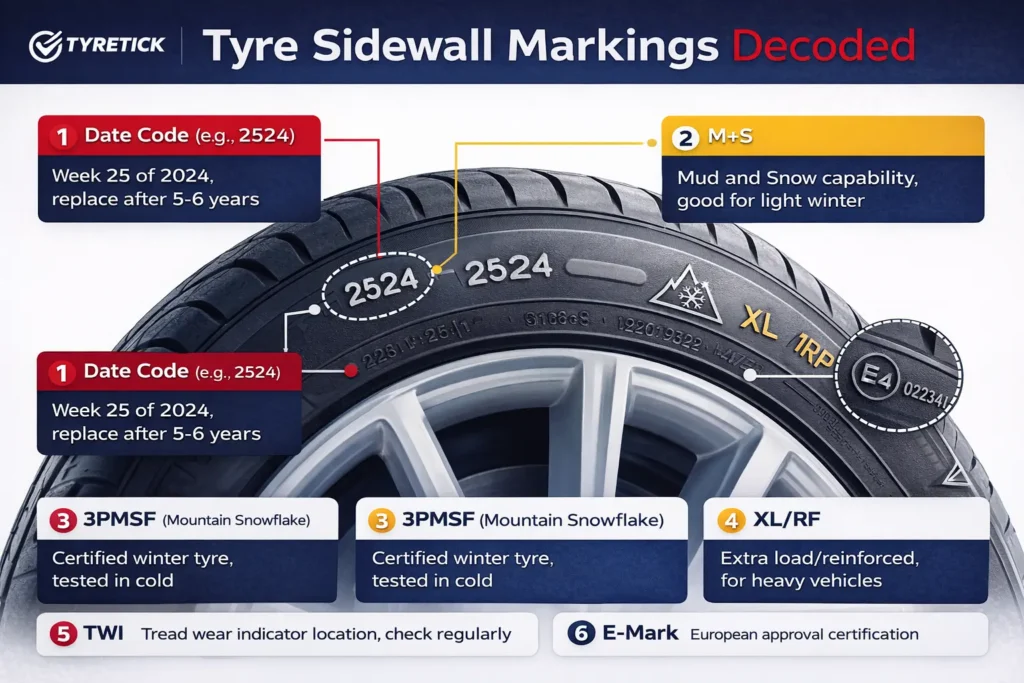
Manufacturing Date Code
Look for four digits. Like 2524. That’s week 25, year 2024.
Tyres older than 5-6 years? Replace them. Rubber degrades even if the tread looks fine.
M+S and Mountain Snowflake Symbol
M+S means Mud and Snow. Decent in light winter conditions.
See a mountain with a snowflake? That’s a proper winter tyre. Passed official cold weather tests.
London rarely needs full winter tyres. All-season tyres work better for our climate. Mild winters. Wet roads. All-seasons handle both.
XL, Reinforced, and Extra Load Markings
See XL or RF on your tyre? That means extra load capacity.
Critical for heavy vehicles. SUVs. Fully loaded vans. Electric cars with heavy batteries.
Speaking of electric vehicles, EV tyres have special requirements. Higher load ratings. Lower rolling resistance. Quieter operation.
Got a Puncture? How to Handle It Safely
Found a flat? Don’t panic. And don’t keep driving.
Driving on a punctured tyre damages the wheel. Sometimes beyond repair. Check our guide on can I drive with a punctured tyre for details.
Your options:
- Use your spare (if you have one)
- Use tyre sealant (temporary fix only)
- Call for puncture repair service (we come to you)
Our mobile fitters carry repair kits and replacement tyres. 30-45 minutes and you’re moving again.
Mobile Tyre Fitting Response Times Across London
Know your tyre size before calling. Speeds everything up.
| London Zone | Average Arrival | Emergency Response |
| Central (Kensington, Camden) | 25-35 minutes | 15-25 minutes |
| Inner (Brixton, Brent, Wembley) | 30-40 minutes | 20-30 minutes |
| Outer (Bromley, St Albans) | 40-50 minutes | 30-40 minutes |
We cover all these areas. Brixton. Kensington. Bromley. And everywhere in between.
Ready to Get Your Tyres Fitted?
You know your tyre size now. That’s the hard part done.
The easy part? Getting them fitted.
Our mobile tyre fitting service comes to you. Home. Work. Roadside. Wherever you are in London.
30-45 minutes. All major brands. No hidden fees. Book online or call us 24/7. We’ll have your new tyres fitted before you know it.
Frequently Asked Questions About Tyre Sizes
Q: What’s the most common tyre size in the UK?
205/55 R16 wins by a mile. It fits most family hatchbacks and saloons. VW Golf, Ford Focus, Vauxhall Astra. All run this size as standard.
Q: Can I put wider tyres on my car?
Sometimes. You need to check the clearance around wheel arches and suspension. Going one size wider often works, but reduce the profile to keep the diameter similar. Your handbook lists approved alternatives.
Q: What happens if I fit the wrong size tyres?
Nothing good. Speedometer errors. Poor handling. Faster suspension wear. Potential MOT failure. Insurance issues if something goes wrong. Stick to approved sizes.
Q: Do all four tyres need to be the same size?
On most cars, yes. But performance cars often run wider rear tyres (staggered fitment). Always check both axles. Never mix sizes on the same axle. For 4×4 vehicles, matching all four is especially important.
Q: How do I know which tyre brand to choose?
Start with size, then budget. Premium brands like Michelin and Continental last longer and perform better. Budget brands work fine for low-mileage drivers.