Sharp objects, or even severely worn tread, can puncture your tyre and force you to take immediate action. It is a challenge all drivers will face at some point in their journey, so they should prepare in advance. Hence, this guide will help you understand the required tools and steps to change a flat tyre on different vehicles.
What Tools and Equipment Do You Need to Change a Tyre?
We recommend keeping the following things ready with you all the time, especially when you are planning long tours:
- Spare tyre that’s fully inflated and in good condition
- A jack to place under the correct jacking point
- Wheel wrench for loosening and tightening wheel nuts
- Wheel chocks or heavy blocks to prevent your vehicle from rolling
- Gloves and a torch if it’s dark
- Tyre pressure gauge to check your spare’s pressure
- For bikes, you will need a tyre lever, a spare tube, and a tube inflator.
How to Change a Punctured Car Tyre?
Once you see a flat tyre, don’t immediately apply the brakes. This could be dangerous. Instead, slowly reduce the speed, look for your surroundings, and park your car on a flat surface only.
Then, follow the steps below to change it:
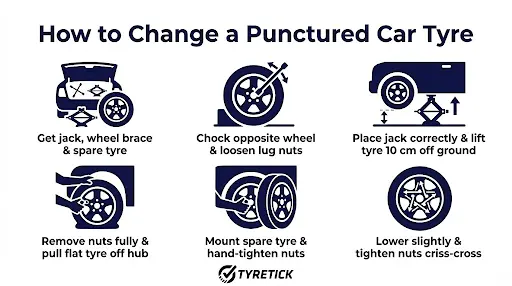
Step 1: After parking your car, get all of your equipment. These include your jack, wheel brace, and spare tyre from the boot.
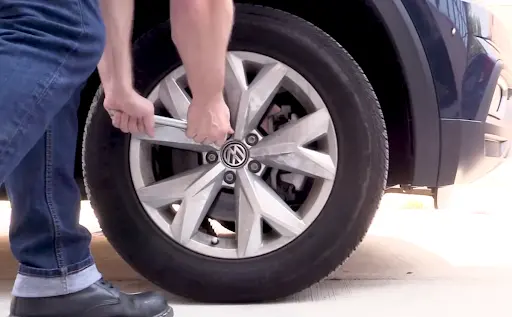
Step 2: Put a wheel chock or heavy object behind a wheel diagonally opposite the punctured one. Use your wheel wrench to turn each lug nut anticlockwise a few turns (preferably 3/4 to 1/2 of a turn) while the tyre is still on the ground. However, don’t remove them fully yet.
Step 3: Now, find the dedicated place to mount the jack. Usually, your car’s frame will have a clear metal area beside the moulded plastic for the jack. Otherwise, check your owner’s manual for the correct jacking point near the flat tyre.
Once you find it, place the jack securely and wind it up until the flat tyre lifts about 10 cm off the ground.
| Pro tip: To make sure the jack does not accidentally settle under your car’s weight and come off balance, place a small wooden piece (2 x 6 inches) under it before raising your car. |
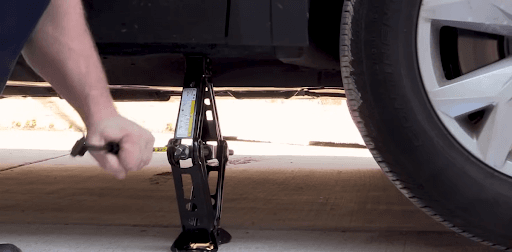
Step 4: Now, remove the wheel nuts fully by hand and place them in a safe spot. Afterwards, pull the tyre straight off the hub and roll it out of the way.
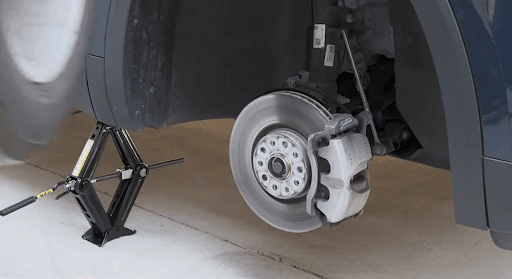
Step 5: Lift the spare wheel onto the hub while also aligning the holes with the studs. Once done, put the nuts on by hand just enough to hold the tyre in place.
Step 6: Use the jack to drop the tyre until it just touches the ground so it cannot spin. Then, turn each nut clockwise firmly in a criss-cross sequence so the tyre sits evenly.
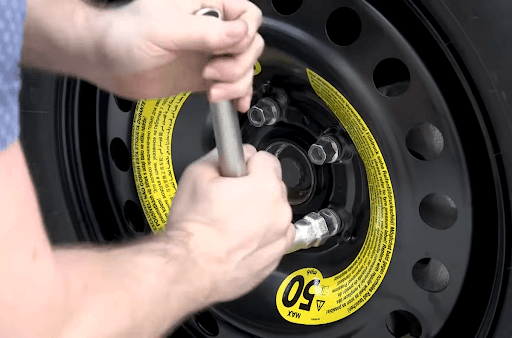
Step 7: In the end, lower the car completely and remove the jack. Collect your equipment and place them in their right place before driving forward.
As a final safety tip, measure the spare’s air pressure with a gauge. Temporary or T-Type tyres often have 60 psi (420 kPa) pressure. If the tyre has less pressure, drive to the nearest service station.
How to Change a Punctured Bike Tyre?
Unlike a car, a punctured tyre on a bike is relatively easier to replace. It also requires less equipment, as the following steps will clarify:
Step 1: Turn your bike upside down, undo the quick-release or axle nuts, and lift the wheel out. Make sure the chain and derailleur clear the cassette so nothing gets stuck in the process.
Step 2: Now, let all the air out to make the tyre easier to work with. Insert a tyre lever between the tyre bead and rim opposite the valve and lift the bead over the rim hook. Afterwards, run the lever around until one side comes off.
Step 3: Pull the inner tube out by its valve, then pull the rest of it out. Check inside the tyre for thorns, glass, or sharp objects and remove anything you find.
Step 4: Partially inflate the new tube to hold its shape, slot the valve through the rim hole, then tuck the tube inside the tyre. Press the tyre bead back onto the rim all around to ensure the tube isn’t pinched.
Step 5: Finally, pump the tyre to the correct pressure as printed on the sidewall, then place the wheel back in the fork or frame and secure it.
How to Change a Punctured Truck/Bus Tyre?
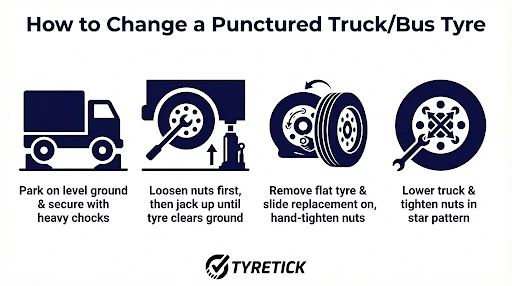
Changing a punctured truck/bus tyre is almost the same as changing a car tyre. You just need heavy equipment, such as a heavy-duty wrench.
If you have a punctured truck tyre, you can follow these steps to change it:
Step 1: Park on level ground and secure with heavy chocks on the opposite side of the flat.
Step 2: Now, use a heavy-duty wrench to break wheel nuts free before lifting. Place the truck jack under a stable jacking point and raise it until the tyre clears the ground.
Step 3: Undo all nuts and pull off the flat tyre to make space for the new tyre. Afterwards, slide the replacement tyre on and tighten the nuts only by hand at first.
Step 4: Finally, lower the truck, then use the wrench to tighten the wheel nuts in a star pattern to ensure even torque.
What Common Mistakes Should You Avoid When Changing a Tyre?
While changing a tyre, you must avoid the following mistakes:
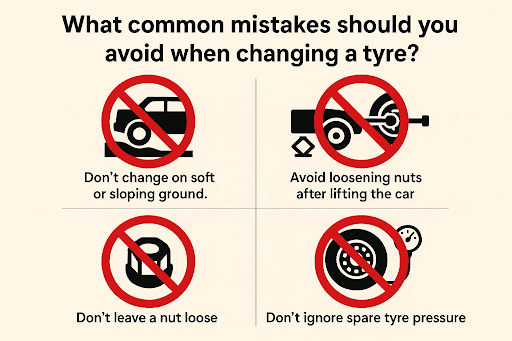
- Don’t change on soft or sloping ground, because the jack can sink or slip.
- Avoid loosening nuts after lifting the car, as this can make wheel removal unsafe.
- Make sure not to leave a nut loose, as uneven tightening can cause wobble at speed.
- Don’t ignore spare tyre pressure, as a flat spare gets you nowhere.
When Should You Call a Professional to Change a Punctured Tyre?
Sometimes, even the detailed steps fail to help you replace a punctured tyre. When you face the following situations, it is better to call professional help:
- If wheel nuts are seized or overtightened so your brace won’t turn them, you’ll likely need specialist help.
- If locking wheel nut keys are missing or broken, you cannot remove the wheel without the correct key.
- If alloy wheels are corroded or stuck to the hub, they may not come off by hand and require a tyre fitter’s tools.
- If the spare tyre is flat, too old, cracked, or doesn’t fit your wheel studs, it cannot be used safely, even if you change it.
- If the tyre sidewall or shoulder is cut, bulged, or damaged, it cannot be repaired on the roadside and needs a professional replacement.
If you prefer fast help at your location, Tyre Tick Fast Tyre offers 24/7 mobile tyre fitting and repair across the UK. We come to your roadside position with all the tools needed within 30 to 45 minutes.
Need Immediate Mobile Tyre Help?
Fast roadside rescue, expert fitting, and friendly support across the UK.
Conclusion
Any driver can face a punctured tyre, but with equipment like a jack, spare tyre, wrench, etc, they can change it easily at the roadside. Simply use the jack to lift the car, remove the lug nuts and the tyre, and install the new tyre. However, when changing a tyre feels out of your scope, professional help from mobile services like Tyre Tick Fast Tyre might be your only bet.
Also, if you are preparing your car for winter roads, you should know whether summer tyres are safe to use in winter conditions and when you must replace them for better safety.
FAQs
1. How long does it take to change a punctured tyre?
Most car tyre changes take 20 to 30 minutes once you are set up at a safe spot. Bikes are quicker, while trucks take longer due to size and weight.
2. Can I drive on a punctured tyre to reach safety?
You can drive a punctured tyre, but only very slowly and very short distances. However, before doing that, it’s important to understand whether it is actually safe to drive with a punctured tyre and what risks you may face.
3. Is the tyre open clockwise or anticlockwise?
Wheel nuts are loosened anticlockwise to open the tyre and tightened clockwise to secure it in place.
4. How to change a flat tyre without a jack?
While you can use wooden logs or bricks as a replacement for a jack, it is still dangerous and not recommended. It is better to call professional mobile tyre fitting services instead.
5. How to find a hole in a punctured tyre?
Listen for hissing, look for sharp objects, or inflate the tube and dip it in water and watch for bubbles to find the hole.