20,000 miles.
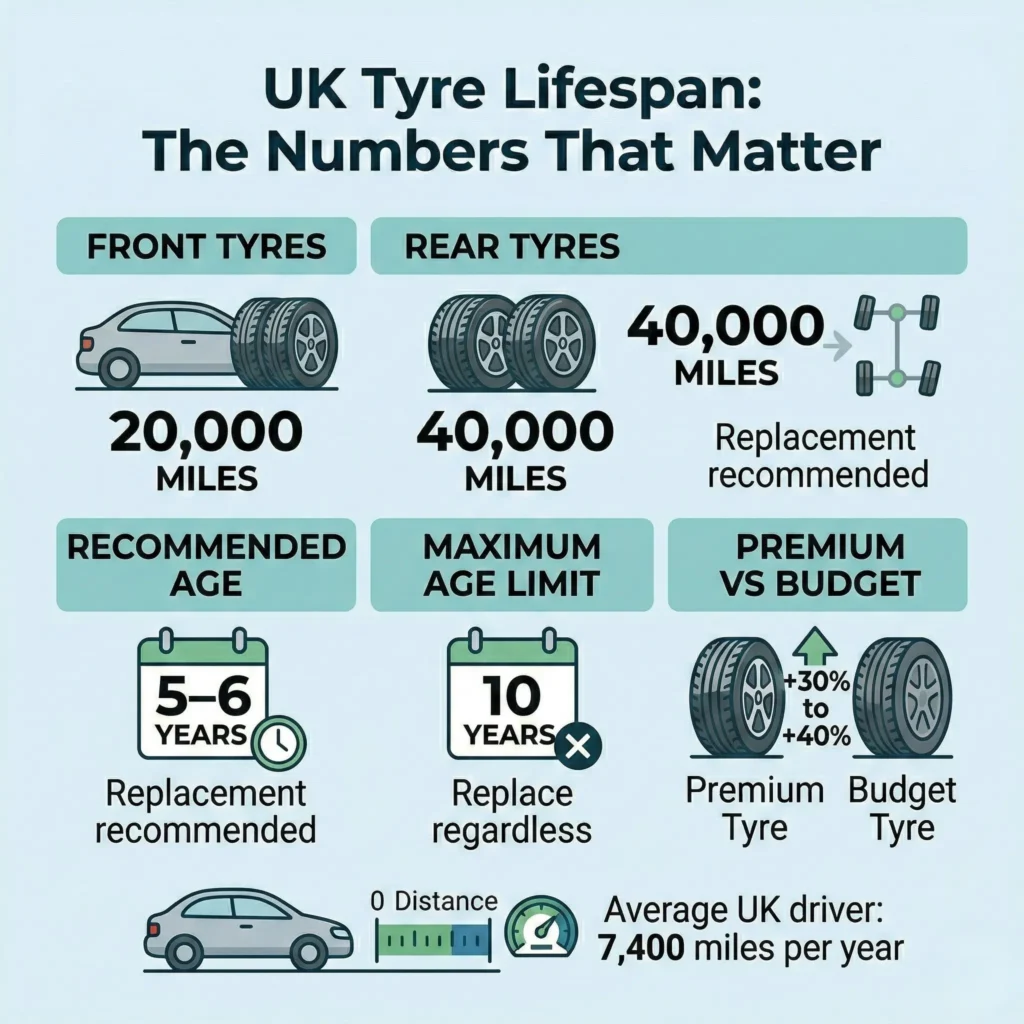
That’s how long your front tyres will last. On average.
Rear tyres? Double that.
But here’s the thing. Those numbers change fast depending on how you drive, where you drive, and what brand sits on your wheels. And if you’re running run flat tyres? Even shorter.
Need new tyres now? Our 24/7 mobile tyre fitting service comes to you. Anywhere in London.
Here’s everything you need to know about tyre lifespan.
Average Tyre Lifespan: The Real UK Numbers
Most drivers get 20,000 to 40,000 miles from a set of tyres.
Sounds like a big range. It is. Here’s why.
Front tyres wear faster. They handle steering, most of the braking, and (on front-wheel drive cars) all the power delivery. Rear tyres just follow along.
The result? Front tyres last roughly 20,000 miles. Rears can stretch to 40,000 miles on a front-wheel drive car.
Tyre Lifespan by Brand Quality
Not all tyres are created equal. Premium brands last longer. Simple.
| Tyre Category | Expected Mileage | Typical Lifespan | Example Brands |
| Premium | 30,000–40,000 miles | 4–6 years | Michelin, Continental, Pirelli |
| Mid-Range | 25,000–35,000 miles | 3–5 years | Hankook, Firestone, Dunlop |
| Budget | 15,000–25,000 miles | 2–4 years | Various lesser-known brands |
Want premium brands fitted at your home? Tyretick stocks Michelin tyres, Continental tyres, and more. Delivered and fitted at your door.
Time vs Mileage: Which Matters More?
Both. And that catches people out.
A tyre that’s done 10,000 miles in 6 years could be more dangerous than one with 25,000 miles in 3 years. Why? Rubber degrades with age. UV exposure, heat, and oxidation harden the compound over time.
The rule? Replace tyres every 5–6 years regardless of tread depth. Maximum absolute age limit? 10 years. No exceptions.
How Long Do Run Flat Tyres Last?
Less than standard tyres. That’s the honest answer.
Run flat tyres typically last 30,000 to 50,000 miles under normal conditions. Sounds decent. But research shows they’re replaced roughly 6,000 miles sooner than conventional tyres.
Why the shorter life?
- Reinforced sidewalls add weight, increasing tread wear
- Stiffer construction means more friction with the road
- Softer tread compounds wear down faster
- If driven flat (even briefly), internal structure weakens
Run Flat vs Standard Tyre Lifespan
| Feature | Run Flat Tyres | Standard Tyres |
| Average Mileage | 17,000–50,000 miles | 20,000–40,000 miles (front) |
| Cost (per tyre) | 25–30% more expensive | Standard pricing |
| Ride Comfort | Stiffer, harsher | Smoother |
| Puncture Safety | Drive 50 miles at 50 mph | Immediate stop required |
| Repairability | Usually not repairable | Often repairable |
Got a puncture on run flats? Don’t risk driving further than 50 miles. Our emergency mobile tyre fitting reaches you fast. 24/7.
When to Change Tyres on Your Car: 7 Warning Signs
Don’t wait for an MOT failure. Check your tyres yourself. Regularly.
Here’s when you need to act.
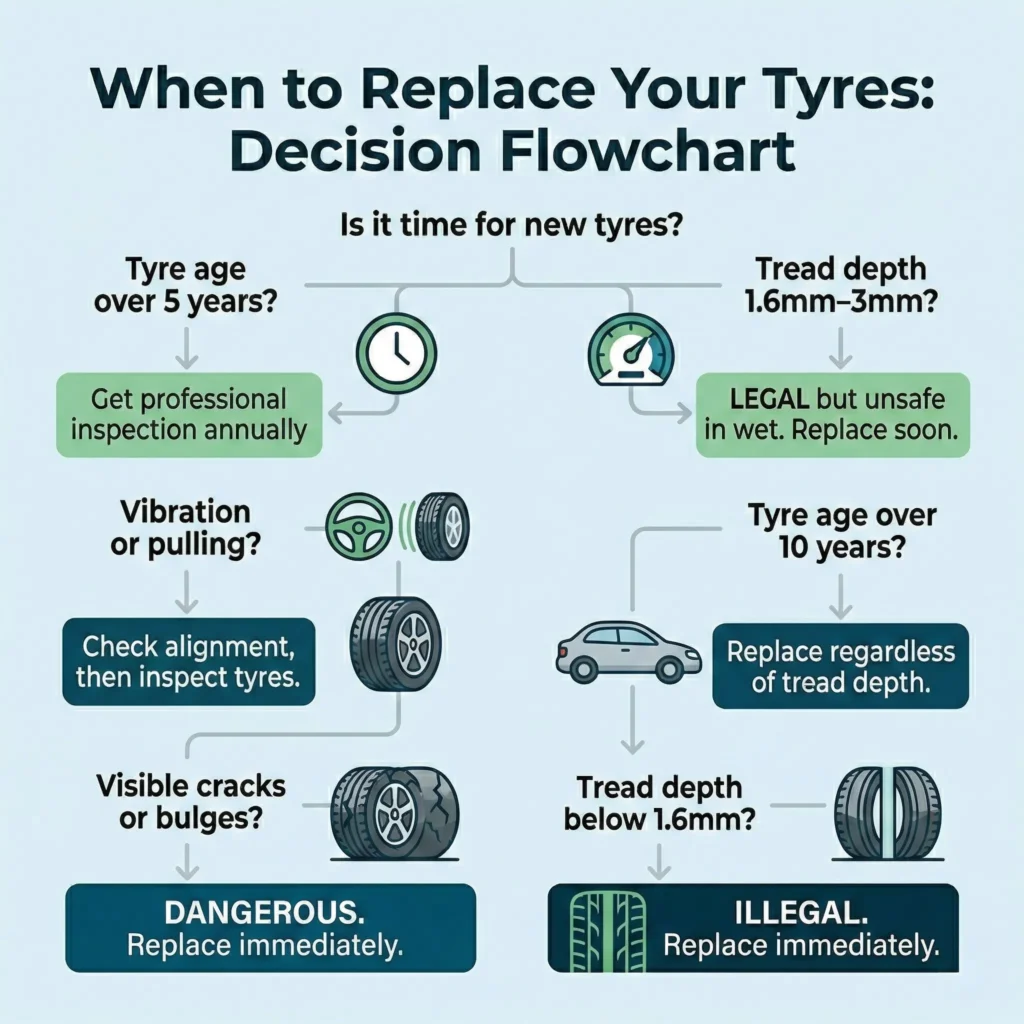
Tread Depth Below 3mm
The legal limit in the UK is 1.6mm. But safety experts say change at 3mm. Why?
Because stopping distances in wet conditions increase massively below 3mm. Research from MIRA found the difference in wet braking distance between 3mm and 1.6mm can be as much as 44%. That’s not a small gap. That’s several car lengths.
Other Critical Warning Signs
- Visible cracks in the sidewall (rubber degradation from age or UV)
- Bulges or blisters on the tyre surface (structural damage inside)
- Vibration at speed that wasn’t there before (possible internal damage)
- Uneven wear patterns (alignment or pressure issues)
- Tyre age over 5 years (check DOT code on sidewall)
- Repeated slow punctures (weak spot that won’t hold)
Spotted any of these? Don’t drive on them. Book a home tyre fitting service and we’ll come to your location.
UK Legal Limit for Tyres: What You Must Know
1.6mm. That’s the number.
The legal minimum tread depth for car tyres in the UK is 1.6mm across the central three-quarters of the tyre, around its entire circumference. Fall below that and you’re breaking the law.
The Penalties Are Brutal
| Offence | Fine | Penalty Points |
| 1 illegal tyre | Up to £2,500 | 3 points |
| 2 illegal tyres | Up to £5,000 | 6 points |
| 4 illegal tyres | Up to £10,000 | 12 points (licence loss) |
Twelve points means automatic disqualification. Gone. Your licence. Your car. Your freedom to drive. All because of worn rubber.
And that’s not the worst part. If you’re in an accident with illegal tyres, your insurance could refuse to pay out. Completely. You’d cover every penny yourself.
The 20p Test: Quick and Free
No fancy tools needed. Grab a 20p coin.
Place it into the main tread grooves. If the outer band of the coin is hidden by the tread, you’re above the legal limit. If you can see the outer band? Your tyres might be illegal. Get them checked. Now.
Do this test every two weeks. It takes 30 seconds per tyre.
How Many Miles Do Tyres Last? Breakdown by Vehicle Type
The answer depends on your car, your tyres, and you.
Here’s a realistic breakdown.
Expected Mileage by Vehicle and Tyre Type
| Vehicle Type | Front Tyres | Rear Tyres | Key Factor |
| Small hatchback | 18,000–25,000 | 30,000–40,000 | Lighter weight helps |
| Family saloon | 20,000–30,000 | 35,000–45,000 | Moderate wear |
| SUV/4×4 | 25,000–35,000 | 30,000–40,000 | Heavier, all-wheel drive |
| Electric vehicle | 15,000–25,000 | 20,000–35,000 | Heavy battery, instant torque |
| Performance car | 12,000–20,000 | 15,000–25,000 | Soft compound, aggressive driving |
Drive an EV? You need specific rubber. Check out our EV tyre range built for the extra weight and torque.
Got a 4×4 or SUV? We carry specialist 4×4 tyres fitted at your location across London.
5 Factors That Kill Your Tyres Early (And Cost You Hundreds)
Most tyres don’t die of old age. They’re murdered.
Here’s what does the damage.
1. Wrong Tyre Pressure
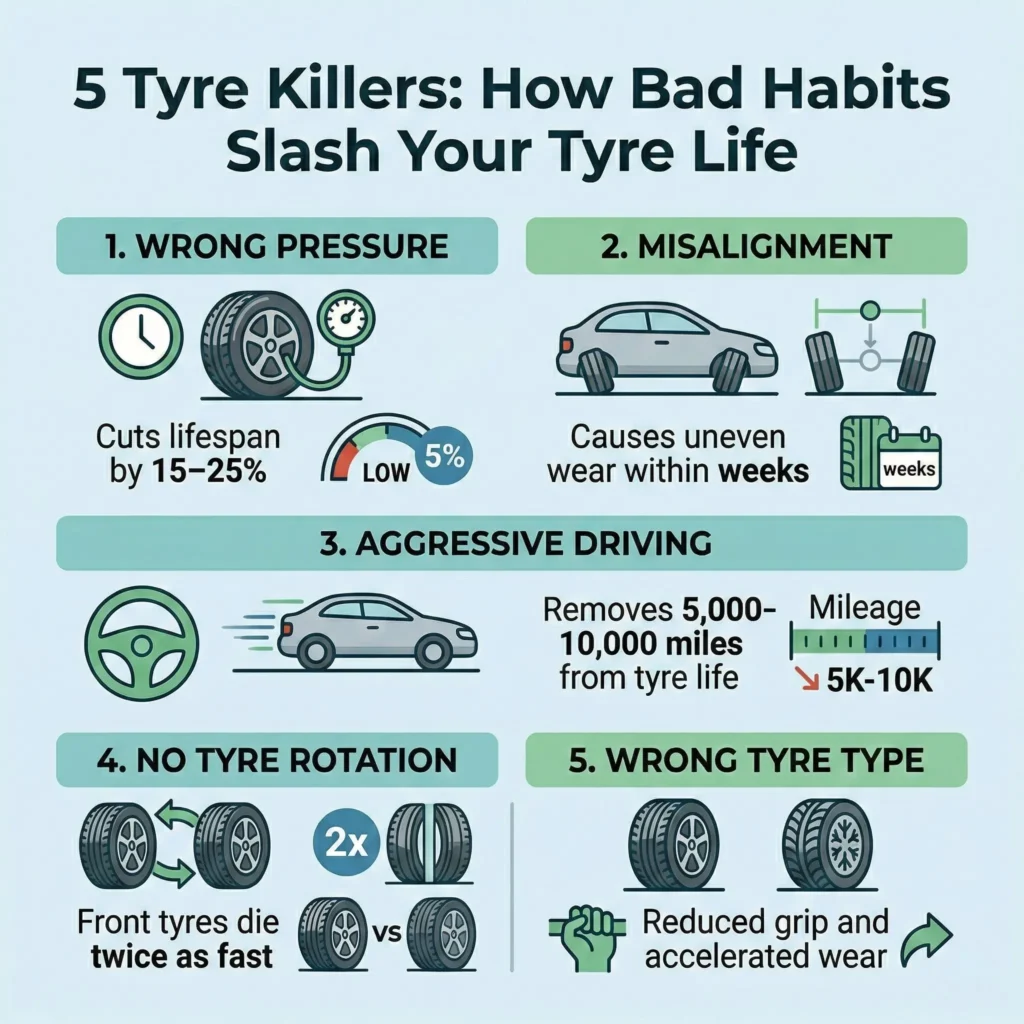
Under-inflated tyres wear the edges. Over-inflated tyres wear the centre. Both cut your tyre life by 15–25%.
Check pressure monthly. Cold tyres. Before you drive. Takes two minutes.
2. Wheel Misalignment
Hit a pothole recently? Your alignment could be off. Even slightly.
Misaligned wheels drag tyres sideways across the road surface. Imagine rubbing an eraser on concrete at an angle. That’s what your tyre goes through with bad alignment.
Our mobile wheel balancing service helps catch these problems early. At your home or office.
3. Aggressive Driving Habits
Hard braking. Fast cornering. Rapid acceleration.
Each one scrubs rubber off your tyres. Smooth driving can add 5,000–10,000 miles to tyre life. Seriously.
4. Never Rotating Your Tyres
Front tyres wear twice as fast as rears on most cars. Rotating them every 6,000–8,000 miles evens out the wear. Simple trick that extends overall tyre life significantly.
5. Using the Wrong Tyres for Conditions
Summer tyres in winter? Bad idea. They harden in cold temperatures and lose grip. All-season tyres are the smart choice for most London drivers. Year-round performance without the hassle of seasonal swaps.
Tyre Age Limit: The Rule Most Drivers Don’t Know
Tyres have a shelf life. Even unused ones.
Most manufacturers recommend professional inspection after 5 years. And replacement by 10 years maximum. Period.
How to Check Your Tyre’s Age (DOT Code)
Look at the sidewall. Find the letters DOT followed by a series of characters. The last four digits tell you when the tyre was made.
Example: DOT XXXX 2621
That means week 26, year 2021. Made in June 2021.
If those last four digits show your tyre is 5+ years old, get it inspected. Over 10 years? Replace it. Full stop. The rubber compounds break down regardless of how much tread remains.
How Often Should You Change Tyres? A Practical Guide
There’s no single answer. It depends on your annual mileage.
Here’s the maths.
| Annual Mileage | Front Tyre Change | Rear Tyre Change |
| 5,000 miles/year | Every 4 years | Every 8 years |
| 10,000 miles/year | Every 2 years | Every 4 years |
| 15,000 miles/year | Every 18 months | Every 2.5–3 years |
| 20,000+ miles/year | Every 12 months | Every 2 years |
The average UK driver covers about 7,400 miles per year. So for most people, front tyres need changing every 2.5–3 years.
But remember the age rule. Even low-mileage drivers should replace tyres by year 5–6.
Frequently Asked Questions
Can I drive on tyres with 2mm tread?
Legally? Yes. Safely? Barely. At 2mm, wet weather braking distances increase significantly compared to 3mm. Most experts recommend replacing at 3mm to stay safe on Britain’s rainy roads.
How do I know if my tyres are too old?
Check the DOT code on the sidewall. The last four digits show the week and year of manufacture. Anything over 5 years needs annual professional checks. Over 10 years needs immediate replacement.
Do all four tyres need changing at the same time?
Not necessarily. But you should always change tyres in pairs (both fronts or both rears). Mixing different tread depths on the same axle is dangerous and affects handling.
What if I get a puncture and can’t change the tyre?
Don’t panic. And don’t drive on it. Call for puncture repair service. We’ll come to your exact location. Day or night.
Is it safe to drive with a punctured tyre?
No. Not unless you have run flats. Read our full guide on can I drive with a punctured tyre for the details.
Keep Your Tyres Legal. Keep Your Family Safe.
Tyres don’t last forever. Front tyres average 20,000 miles. Rears around 40,000. Run flats wear out faster. And age matters just as much as mileage.
Check your tread depth every two weeks. Look for cracks and bulges monthly. Know your DOT code. Replace at 3mm if you want real safety, not just legal compliance.
And when it’s time for new tyres?
Don’t waste hours at a garage. Contact Tyretick for fast mobile tyre fitting across London. We come to your home, office, or roadside. 24/7. All major brands. No hidden costs.
Your tyres. Your safety. Sorted.