Your Tesla shows a tyre warning. Again.
You fitted standard tyres six months ago. They’re already wearing thin.
Sound familiar?
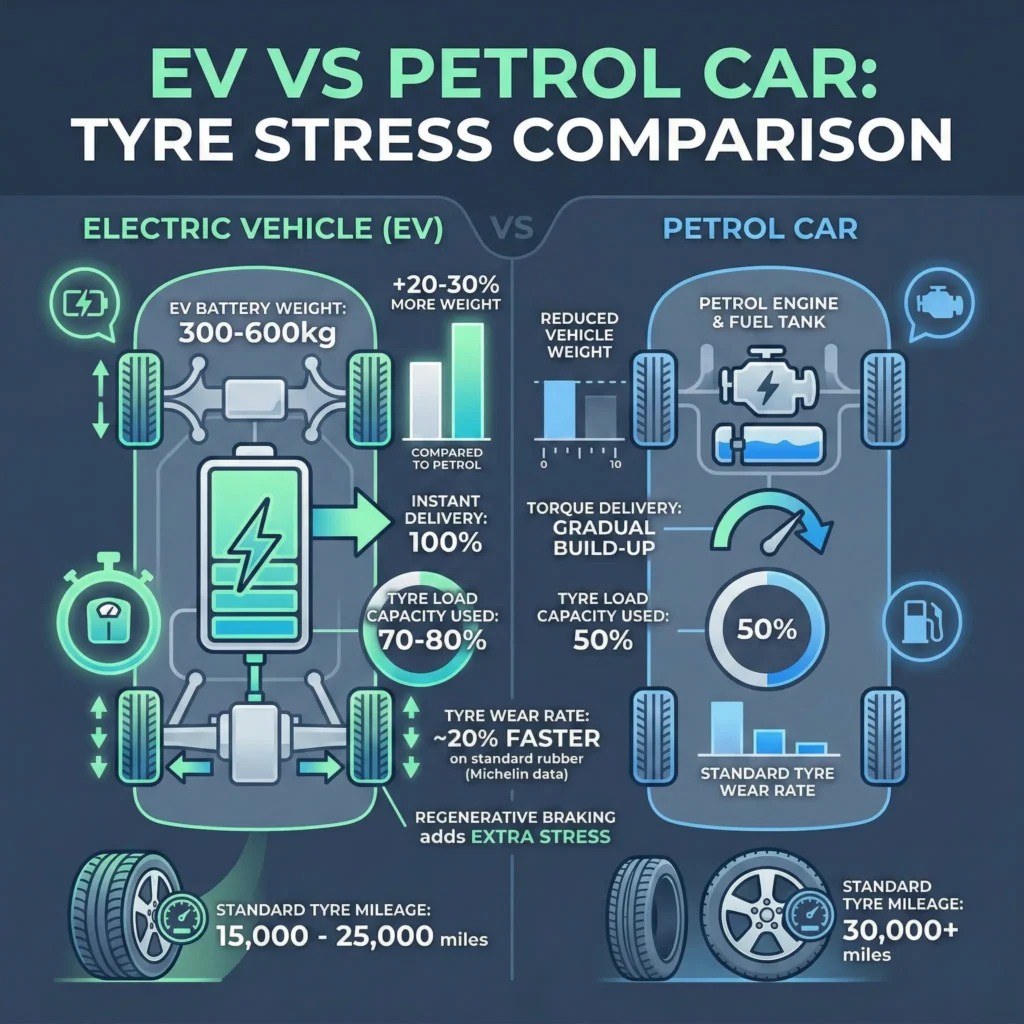
Here’s the problem. Electric cars chew through regular tyres. Fast. The extra weight from batteries and instant torque destroys conventional rubber 20% quicker, according to Michelin’s own data.
That’s why EV tyres exist. And choosing the right ones matters more than you think. Our mobile tyre fitting service in London fits EV-specific tyres at your location, 24/7.
Why Electric Cars Wear Tyres Faster Than Petrol Cars
Three things kill tyres on EVs. Weight. Torque. Braking.
The Weight Problem
EV batteries are heavy. Really heavy. The average EV battery weighs around 400kg. That’s like having four extra passengers permanently sitting in your car.
This extra load pushes tyres harder into the road. More contact pressure. More friction. More wear.
Standard tyres can’t handle that kind of stress over time. They bulge. They wear unevenly. And they lose grip faster.
Instant Torque Destroys Regular Tyres
Electric motors deliver 100% torque from standstill. Immediately. No building up through revs like a petrol engine.
Every time you pull away from traffic lights? Your tyres take a hit. Every acceleration on the motorway? More rubber shredded.
Regular tyres simply aren’t built for that repeated punishment.
Do Electric Cars Need Special Tyres? The Real Answer
Yes. Absolutely.
Can you physically fit standard tyres on an EV? Sure. Will they work safely for long? No.
Garages across London regularly see EVs arriving on shredded conventional tyres. The drivers had no idea they needed something different.
What Makes EV Tyres Different From Standard Tyres
Four key differences set EV tyres apart:
| Feature | EV Tyres | Standard Tyres |
| Sidewall Strength | Reinforced for 300-600kg extra load | Standard load rating |
| Rubber Compound | Harder, more durable blend | Softer, wears faster under EV weight |
| Rolling Resistance | Low (extends battery range 7-12%) | Higher (drains battery faster) |
| Noise Reduction | Built-in foam or silent tech | No noise insulation |
| Load Rating | XL or HL rated (heavy load) | Standard load capacity |
| Tread Design | Optimised for weight distribution | Designed for lighter vehicles |
The Range Factor Nobody Talks About
Here’s what most people miss. Wrong tyres kill your range.
EV tyres with low rolling resistance can add 30-60km to your range per charge. That’s the difference between making it home and being stranded.
Standard tyres create more friction. More friction means your battery works harder. You lose 7-12% of range. On a 400km battery, that’s 28-48km gone.
Simple maths. All-season tyres designed for EVs solve this problem year-round.
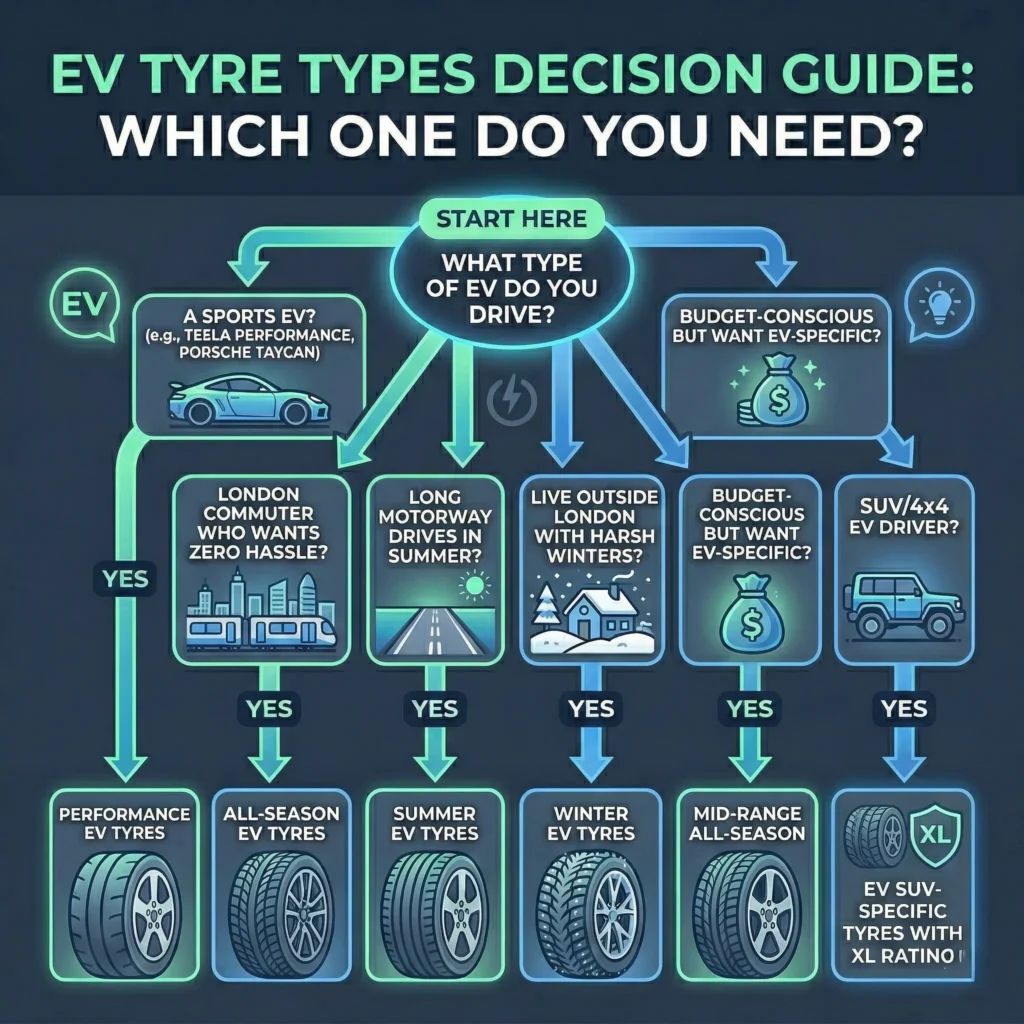
Types of EV Tyres: Which Ones Fit Your Driving Style?
Not all EV tyres are the same. Different driving needs call for different rubber.
EV Summer Tyres
Best for: April to October. Dry and wet grip in warm conditions.
These offer peak performance in temperatures above 7°C. Shorter braking distances. Better handling. But they struggle in cold weather.
EV All-Season Tyres
Best for: Year-round London driving. No seasonal swaps needed.
For most UK drivers? This is the smart choice. You get decent performance in all conditions without changing tyres twice a year. Good enough in summer. Good enough in winter. Perfect for London’s unpredictable weather.
EV Performance Tyres
Best for: Sports EVs like Tesla Model 3 Performance, Porsche Taycan.
These handle instant torque brilliantly. Higher cornering stiffness. Superior grip at speed. But they wear faster and cost more. If you drive a performance EV, they’re worth every penny.
EV Winter Tyres
Best for: November to March. Cold temperatures, ice, light snow.
Softer rubber compound stays grippy below 7°C. Essential if you commute in freezing conditions. But are summer tyres really OK in winter? Most experts say no.
| EV Tyre Type | Best Season | Grip Level | Wear Rate | Noise | Price Range |
| Summer | April-Oct | Excellent (dry/wet) | Moderate | Low | £80-£200 |
| All-Season | Year-round | Good (all conditions) | Moderate | Low-Medium | £70-£180 |
| Performance | April-Oct | Outstanding | Fast | Medium | £120-£300+ |
| Winter | Nov-March | Excellent (cold/ice) | Moderate | Medium | £90-£200 |
Best EV Tyres in the UK: Top Picks for 2026
Which brands actually deliver? Here’s what independent tests and real-world driving show.
Premium EV Tyres (Best Performance)
Michelin Pilot Sport EV
The benchmark. Michelin designed this specifically for electric sports cars. It adds 60km of range compared to standard tyres, reduces perceived noise by 20%, and delivers 15% more cornering stiffness.
Fitted as original equipment on Tesla, Porsche, and Mercedes-AMG EVs. That tells you everything.
Hankook iON evo
The test winner. Hankook took first place in AutoBild’s 2025 EV tyre test. Shortest wet braking distance at 39.6m. Best dry handling. Plus it’s the official tyre supplier for Formula E.
Serious credentials. Competitive pricing too.
Continental EcoContact 6
The efficiency king. Continental built this with 15% lower rolling resistance and 20% higher mileage than its predecessor. EU A-rated for fuel efficiency. A solid choice for range-focused drivers.
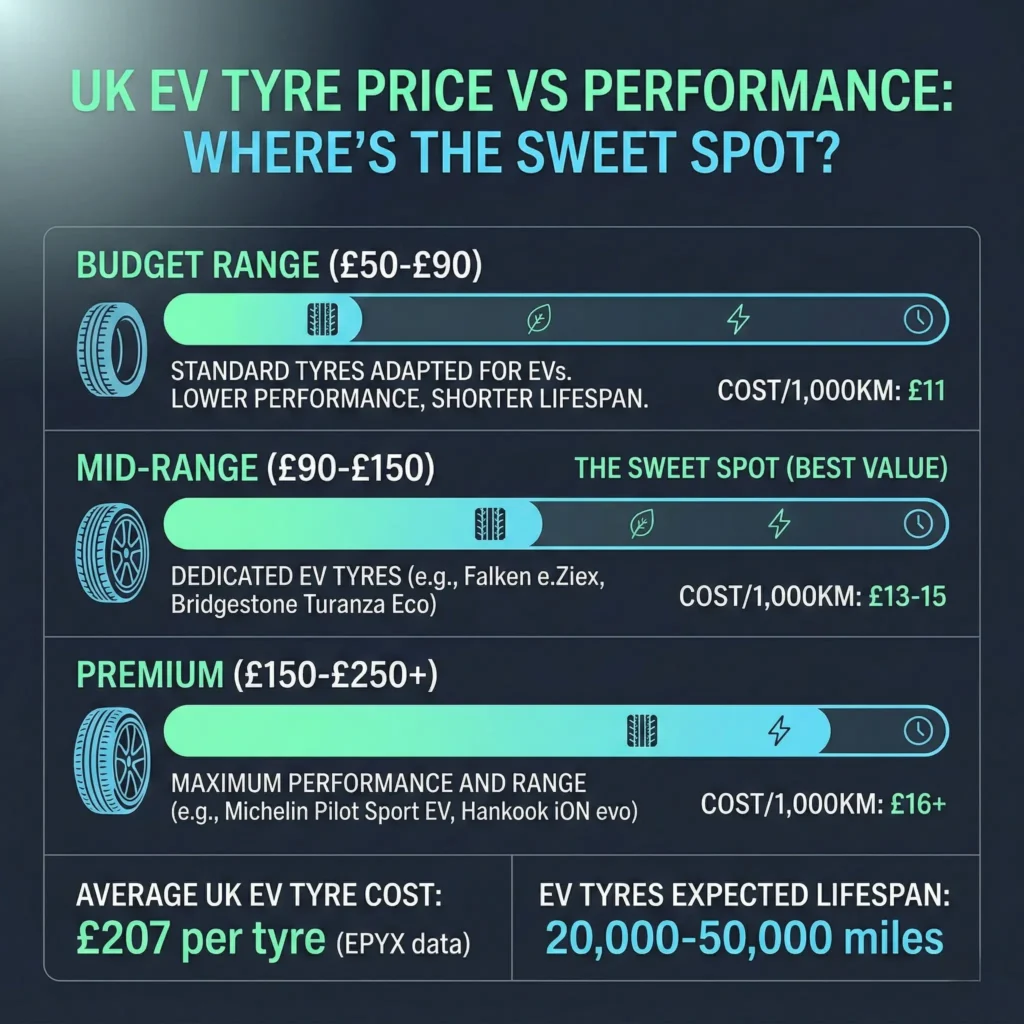
Mid-Range EV Tyres (Best Value)
Falken e.Ziex
The value champion. Lowest rolling resistance in the 2025 AutoBild EV test. That translated to 410km of range, 65km more than the worst performer. Built-in Silent Core noise technology. And it costs significantly less than Michelin or Continental.
Bridgestone Turanza Eco
The eco warrior. Bridgestone‘s Enliten Technology reduces rolling resistance by 30% and tyre weight by 20%. EU A-rated for fuel efficiency, B for wet grip. Great for eco-conscious drivers.
| Brand/Model | Type | Price (per tyre) | Range Boost | Noise Level | Best For |
| Michelin Pilot Sport EV | Performance | £130-£250 | +60km | Very quiet | Sports EVs |
| Hankook iON evo | Performance | £100-£200 | +40-50km | Quiet | All-round performance |
| Continental EcoContact 6 | Eco/Touring | £90-£170 | +30-45km | Quiet | Range-focused driving |
| Falken e.Ziex | Eco/Touring | £70-£140 | +50-65km | Very quiet | Best value |
| Bridgestone Turanza Eco | Eco/Touring | £80-£160 | +35-50km | Quiet | Eco-conscious drivers |
EV Tyre Maintenance: 5 Mistakes That Cost London Drivers £200-£500
Buying the right EV tyres is step one. Maintaining them is step two. Get it wrong and you’ll pay twice.
Running Wrong Pressure
EVs are heavy. Under-inflated tyres on a 2-tonne EV wear dramatically faster. They also drain your battery. Check pressure monthly. Minimum.
Skipping Tyre Rotation
Regenerative braking hammers front tyres. If you don’t rotate every 8,000-10,000 miles, your fronts will be bald while your rears are still fine. Uneven. Expensive. Dangerous.
Ignoring Wheel Alignment and Balancing
The extra weight of EVs amplifies alignment issues. What would cause minor uneven wear on a petrol car causes serious problems on an EV. Get mobile wheel balancing done when fitting new tyres. Always.
Fitting Standard Tyres to Save Money
False economy. Standard tyres on EVs last 15,000-25,000 miles. EV-specific tyres last 30,000-50,000 miles. You’ll replace standard tyres twice before EV tyres need changing once. Do the maths.
Driving on Damaged Tyres
Noticed a bulge or sidewall crack? Stop. Immediately. With the weight of an EV, damaged tyres are far more dangerous than on lighter petrol cars. A blowout at speed in a 2.5-tonne EV is catastrophic. If you spot damage, call for an emergency tyre fitting service. Don’t risk it.
How to Choose the Right EV Tyres for Your Car
Follow these five steps. Get it right first time.
Step 1: Check Your Sidewall Markings
Your current tyre sidewall shows the exact size you need. Something like 225/45 R17. Any replacement must match these numbers exactly. If you can’t read the markings or need help, any professional fitter can check for you.
Step 2: Look for EV-Specific Markings
Check for EV, E, or manufacturer-specific markings on the sidewall. Continental uses ‘EV’. Michelin uses specific model names. Some brands mark XL or HL for heavy load rating. These matter for your EV.
Step 3: Prioritise Low Rolling Resistance
Check the EU tyre label. You want A or B for energy efficiency. Every grade lower costs you range. For London city driving where you’re constantly stopping and starting, this makes a real difference to your daily charge.
Step 4: Consider Noise Ratings
EVs are quiet. Your tyres shouldn’t be loud. Look for tyres with foam insulation or specific noise-reduction tech. The EU label shows noise ratings in decibels. Lower is better.
Step 5: Match Your Driving Style
Aggressive driver? Performance EV tyres. Long commuter? All-season with low rolling resistance. 4×4 or SUV EV? You’ll need XL-rated tyres built for the extra weight.
Frequently Asked Questions About EV Tyres
Q: Can I put normal tyres on my electric car?
Physically, yes. Should you? No. Standard tyres wear 20% faster on EVs, reducing your range by 7-12%, and increasing braking distances. You’ll spend more replacing them frequently than buying proper EV tyres once. If you’ve got a punctured tyre on your EV, always replace it with EV-specific rubber.
Q: Are EV tyres more expensive than normal tyres?
Slightly. The average EV tyre costs around £207 in the UK compared to £90-£130 for standard equivalents. But they last significantly longer on EVs. The cost-per-mile actually works out cheaper with proper EV tyres.
Q: How long do EV tyres last?
Between 20,000 and 50,000 miles. Huge range, right? It depends on your driving style, tyre brand, and how well you maintain them. Aggressive drivers in London traffic will see shorter life. Gentle motorway commuters get the most mileage.
Q: Can I get EV tyres fitted at home in London?
Absolutely. Our home tyre fitting service brings EV-specific tyres to your door. We carry all major brands including Michelin, Continental, Hankook, and Bridgestone. Available 24/7 across London, including Kensington, Brent, Bromley, and more.
Q: Do EV tyres affect my car’s range?
Massively. The right EV tyres can add 30-60km to your range per charge. Wrong tyres drain your battery 7-12% faster. On a 400km battery, that’s up to 48km of range lost. Every single charge.
Get the Right EV Tyres Fitted in London. Today.
EV tyres aren’t optional. They’re essential.
The right tyres protect your battery range. They keep you safe on London’s wet roads. They last longer. And they actually save you money over time.
Whether you drive a Tesla, BMW i4, Hyundai Ioniq, or any other EV, proper tyres make a measurable difference to how your car drives, stops, and performs.Need EV tyres fitted? Contact Tyretick for 24/7 mobile tyre fitting across London. We bring EV-specific tyres to your location. All major brands stocked. No hidden costs. Fast.