“My run flat has a nail. Can you patch it?”
We hear this three times a week. Minimum.
Short answer? Usually no.
Most puncture repair services won’t touch a run flat. And for good reason.
But there are exceptions. Here’s what actually determines whether your run flat can be saved. Or whether you need emergency mobile tyre fitting in London for a full replacement.
Why Most Run Flat Tyres Can’t Be Repaired (The Real Reason)
Here’s the thing most people miss.
Run flat tyres have reinforced sidewalls. Thicker rubber. About 6 times thicker than standard tyres. That’s what keeps you moving after a puncture.
Problem? That same reinforcement hides damage.
The Hidden Damage Issue
When you drive on a flat run flat (yes, people do this), the internal structure takes a beating. Microscopic cracks form inside the sidewall. You can’t see them from outside.
A tyre technician can’t see them either. Not always.
That’s the core problem. The reinforced structure masks secondary damage. And if that damage goes undetected? Blowout risk.
What British Standards Say
BS AU 159 is the standard most UK garages follow for tyre repairs. It sets strict criteria: puncture location, size, and tyre condition all matter.
Run flats add extra complexity. Because you can’t fully inspect the internal structure after it’s been driven on flat, most technicians refuse the repair. Not because they’re trying to sell you a new tyre. Because they can’t guarantee your safety.
Simple as that.
What Each Tyre Manufacturer Actually Says About Run Flat Repair
This is where it gets interesting. Not every brand says the same thing.
We checked directly with the major manufacturers. Some say yes with conditions. Others say absolutely not.
| Tyre Brand | Can Repair? | Conditions | Run Flat Name |
| Goodyear | Yes (with conditions) | Professional inspection, tyre history known | ROF |
| Dunlop | Yes (with conditions) | Qualified professional, no doubt about history | DSST |
| Bridgestone | Yes (limited) | Must check for inner liner creasing/cracking | RFT / DriveGuard |
| Continental | No | Internal damage not visible, too risky | SSR |
| Michelin | No (generally) | Do not recommend repair | ZP |
| Pirelli | No (generally) | Replacement recommended after puncture | r-f |
Notice the pattern? Even brands that allow repair add “in case of doubt, do not repair.” That’s a big caveat.
The Goodyear Exception
Goodyear is the most repair-friendly of the bunch. Their Goodyear run flat tyres can be repaired by a qualified professional after thorough inspection. But only one repair per tyre lifetime. Ever.
The Continental Hard No
Continental tyres with SSR technology? Continental says don’t repair them. Period. The hard inserts inside the sidewall can sustain invisible damage even from minor underinflation.
You wouldn’t know until it fails. And by then it’s too late.
Run Flat Tyre Repair Cost: What You Actually Pay in 2026
Let’s talk money. Because that’s usually the real question.
Repair or replace? Your wallet cares.
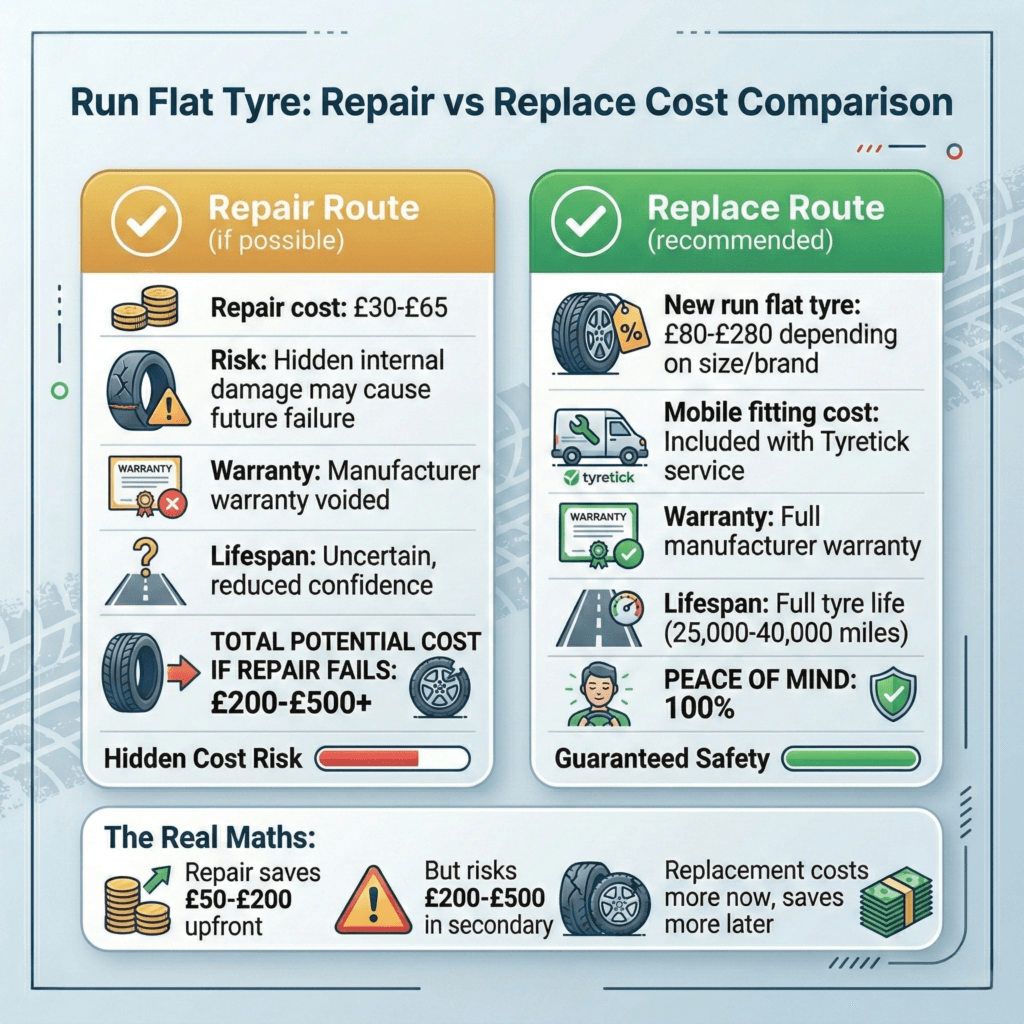
Repair Costs (When Repair Is Possible)
If a technician agrees to repair your run flat, expect to pay more than a standard tyre repair.
| Service | Standard Tyre | Run Flat Tyre | Why More? |
| Garage puncture repair | £20-£30 | £30-£45 | Harder to remove/refit |
| Mobile puncture repair | £35-£45 | £45-£65 | Specialist equipment needed |
| Inspection fee (no repair) | £0-£15 | £15-£25 | Detailed internal check required |
Run flat repairs cost 1.5 to 2 times more than standard tyres. The reinforced sidewalls need specialist equipment to remove safely. Takes longer too.
Replacement Costs (The More Likely Outcome)
Here’s the number most people actually need.
| Tyre Size | Budget Run Flat | Mid-Range | Premium Brand | Common Vehicles |
| 195/55R16 | £80-£110 | £100-£140 | £130-£180 | BMW 1 Series, MINI |
| 205/55R16 | £90-£120 | £110-£150 | £140-£200 | BMW 3 Series, Mercedes C-Class |
| 225/45R17 | £100-£140 | £130-£170 | £160-£230 | BMW 3 Series, Audi A4 |
| 225/40R18 | £120-£160 | £150-£200 | £190-£280 | BMW 4 Series, Mercedes E-Class |
| 255/40R19 | £140-£190 | £180-£240 | £230-£320 | BMW 5 Series, Audi A6 |
Yes. Run flat tyres cost 20-25% more than standard tyres. That’s the premium for reinforced sidewall technology.
But consider this. A run flat saves you the cost of roadside assistance. The time of a garage visit. And the stress of changing a tyre at midnight on the M25. With mobile tyre fitting in London, you can have a replacement fitted at your location within the hour.
Can You Patch a Run Flat Tyre Yourself? DIY Kits and Why Experts Say No
Tempting. We get it.
A £5 plug kit from the petrol station. 10 minutes work. Back on the road.
Don’t.
Why DIY Kits Don’t Work on Run Flats
Three reasons. All serious.
- The reinforced sidewall rubber is much thicker. Standard plug tools often can’t penetrate it properly.
- Sealant products (like tyre weld) are incompatible with run flat internal structures. They can actually make things worse.
- You can’t inspect the inside of the tyre without removing it. And removing a run flat requires specialist equipment.
Plus, using a DIY sealant voids your tyre warranty. And potentially your vehicle warranty too. If you’re unsure whether you can drive with a punctured tyre, the safest answer is: get professional help.
What About Tyre Shops That Refuse to Help?
Common frustration. You go to a shop. They say no. You try another. Same answer.
It’s not a conspiracy to sell new tyres. Most shops follow BS AU 159 guidelines and their own liability policies. Repairing a run flat and having it fail? That’s a lawsuit waiting to happen.
Your best option? Call a 24/7 mobile tyre fitting service. A qualified fitter can inspect the damage at your location and give you an honest assessment. No wasted trips to multiple shops.
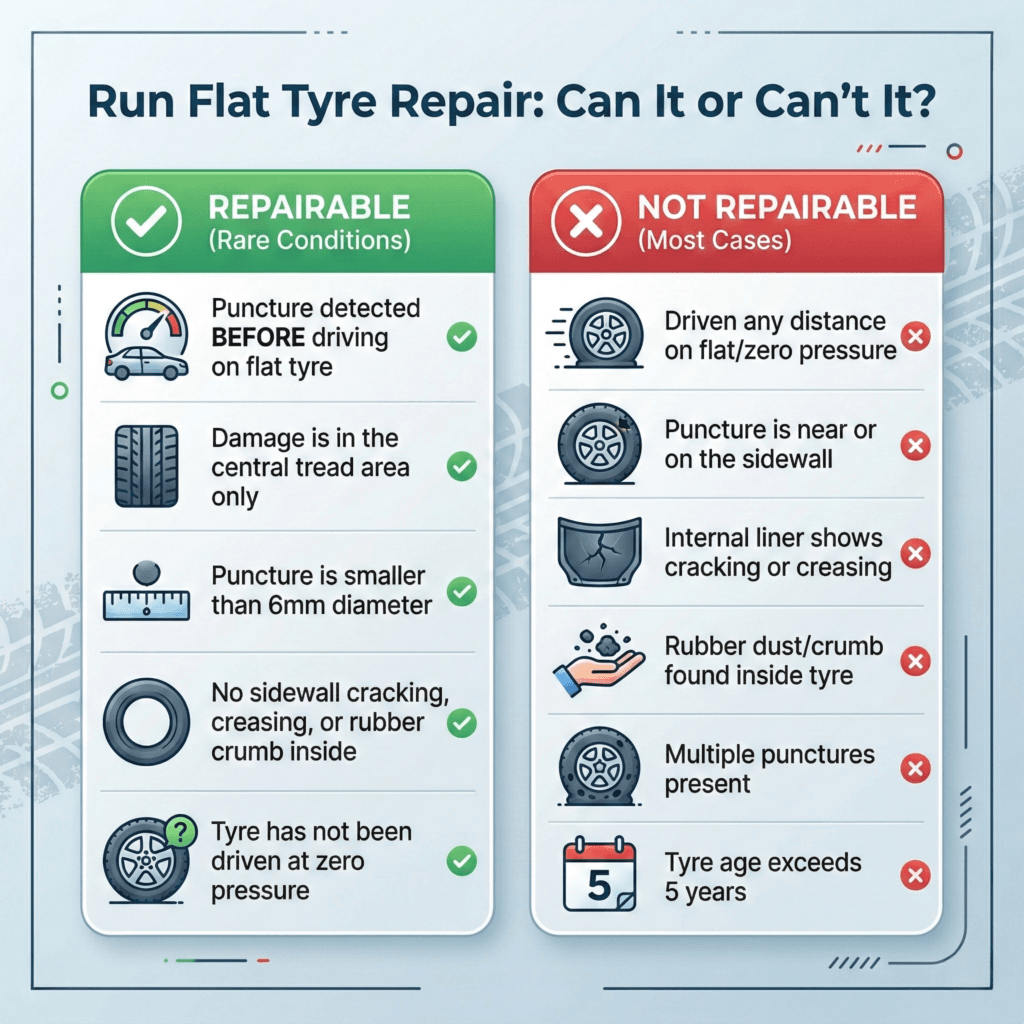
5 Conditions Where a Run Flat Tyre Repair Might Work
Rare. But possible. All five conditions must be met. Not four. All five.
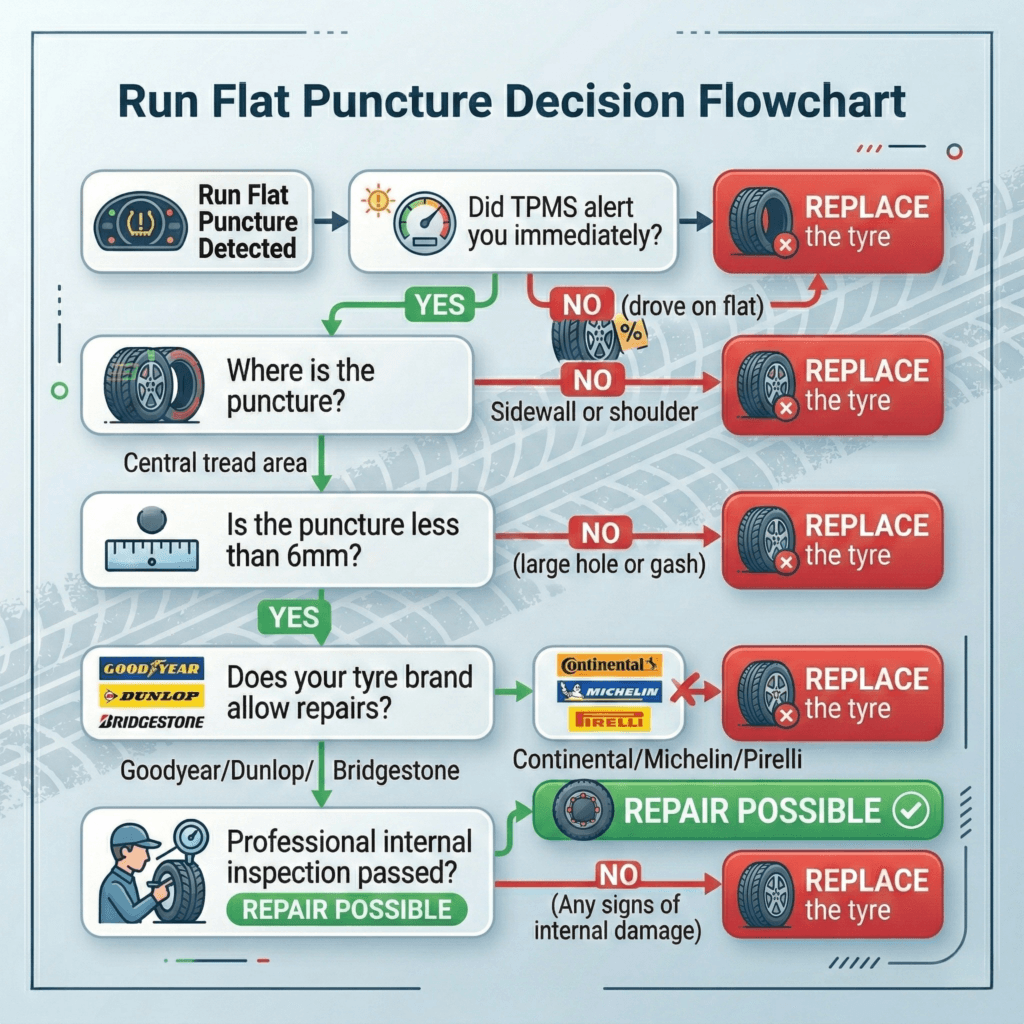
1. The puncture was caught before you drove on flat. TPMS alert went off and you stopped immediately.
2. Damage is in the central 75% of the tread. Not the shoulders. Not the sidewall. Central tread only.
3. The puncture is less than 6mm in diameter. A small nail? Maybe. A screw that ripped a gash? No chance.
4. Internal inspection shows no cracking, creasing, or rubber crumb. This requires removing the tyre from the wheel and checking carefully.
5. The tyre manufacturer allows repairs. Check the table above. Continental and Michelin say no regardless.
Miss even one? Replacement is your only safe option.
How Run Flat Tyre Replacement Works with Mobile Fitting
So your run flat can’t be repaired. Now what?
Good news. You don’t need to visit a garage.
Home tyre fitting services bring the replacement directly to you. At your house, office, or even the side of the road.
The Mobile Fitting Process for Run Flats
| Step | What Happens | Time | Your Involvement |
| 1. Book | Call or book online, confirm tyre size | 2-3 mins | Provide vehicle details |
| 2. Arrival | Mobile fitter arrives with equipment | 25-50 mins | None (carry on with your day) |
| 3. Removal | Old run flat removed with specialist tools | 10 mins | None |
| 4. Fitting | New run flat installed and balanced | 15-20 mins | None |
| 5. Checks | Pressure check, TPMS reset, safety verify | 5 mins | Quick sign-off |
Total time from call to road-ready? About 60-90 minutes.
That includes travel time. Compare that to 2-3 hours at a garage. With mobile wheel balancing included, your wheels are perfectly balanced before you drive off.
Do You Need to Replace All Four?
Not necessarily. But there are rules.
If the other three tyres have similar tread depth (within 2-3mm), you can replace just the damaged one. If there’s a big difference, you may need to replace in pairs (front or rear axle) for safety.
Your fitter will check and advise. Honestly.
Frequently Asked Questions
Q: Can run flat tyres be patched with a standard puncture repair kit?
No. Standard repair kits aren’t designed for the reinforced sidewall structure. The thicker rubber requires specialist tools and the internal damage check can only be done professionally. Always get a qualified technician to assess run flat damage.
Q: How much does it cost to repair a run flat tyre in the UK?
If repair is possible (and it rarely is), expect £30-£65 depending on the service provider. Mobile repair costs slightly more due to equipment and travel. However, most run flats end up needing full replacement at £80-£280 per tyre.
Q: Are Bridgestone run flat tyres repairable?
Technically yes, but with strict conditions. Bridgestone tyres follow BSAU159 G standards for repair. But the inner liner must be inspected for creasing, cracking, or rubber crumb. Any evidence of driving at low pressure means replacement only.
Q: Can I switch from run flat tyres to regular tyres?
Yes. But you’ll lose the ability to drive on a flat. And you’ll need to carry a spare tyre or repair kit. Check your vehicle handbook first. Some cars have suspension tuned specifically for run flats. Consider all-season tyres as an alternative if switching.
Q: How far can I drive on a punctured run flat tyre?
Most manufacturers say 50 miles maximum at 50mph maximum. But that’s the upper limit, not a target. Drive as little as possible. The further you go, the more internal damage occurs. And the less chance of repair.
Q: Will my insurance cover run flat tyre replacement?
Standard car insurance doesn’t cover tyre damage from punctures or road debris. Some breakdown policies include tyre cover as an add-on. Check your policy. Either way, the fastest solution is calling a mobile fitting service.
The Bottom Line on Run Flat Tyre Repair
Can run flat tyres be repaired? Sometimes. Rarely. With conditions.
Can they be patched with a DIY kit? No. Never.
Is replacement usually the safer and smarter option? Yes. Almost always.
The cost stings. We won’t pretend otherwise. But a run flat that fails at 70mph on the M25? That costs a lot more than £150.
Need a run flat replacement in London? Tyretick offers 24/7 mobile tyre fitting across London. We carry all major brands including Michelin, Pirelli, and Continental. Fast. Professional. At your location.
Contact Tyretick now for a free quote. We’ll be there fast.