“My BMW needs new tyres. Run flats cost double.”
That’s what Dan told us last Thursday. He wasn’t wrong.
Run flat tyres cost 20-25% more than standard tyres. Sometimes more.
But here’s the thing. They might save your life. Or they might waste your money. It depends on how you drive, where you drive, and what you drive. If you’re dealing with a flat tyre right now, our 24/7 emergency mobile tyre fitting team can help. Fast.
Let’s break it down. Properly. With real numbers and honest answers about mobile tyre fitting in London options.
What Are Run Flat Tyres? The 30-Second Version
Run flat tyres have reinforced sidewalls. Thicker. Stronger. Built to hold your car’s weight even with zero air pressure.
Puncture happens? You keep driving. Up to 50 miles at 50mph. That’s the standard across most manufacturers.
Simple.
Two Types You Need to Know
Self-supporting run flats:
- Reinforced sidewalls carry vehicle weight
- Most common type on UK roads
- Used by BMW, Mercedes, Mini
Support ring systems:
- Hard rubber ring inside the tyre
- Supports weight when air is lost
- Less common, found on some luxury vehicles
Both types need a working TPMS (Tyre Pressure Monitoring System). Without it, you won’t know you’ve got a puncture. Run flats don’t sag like normal tyres. No wobble. No pull. The TPMS warning light is your only alert.
How Do I Know If I Have Run Flat Tyres?
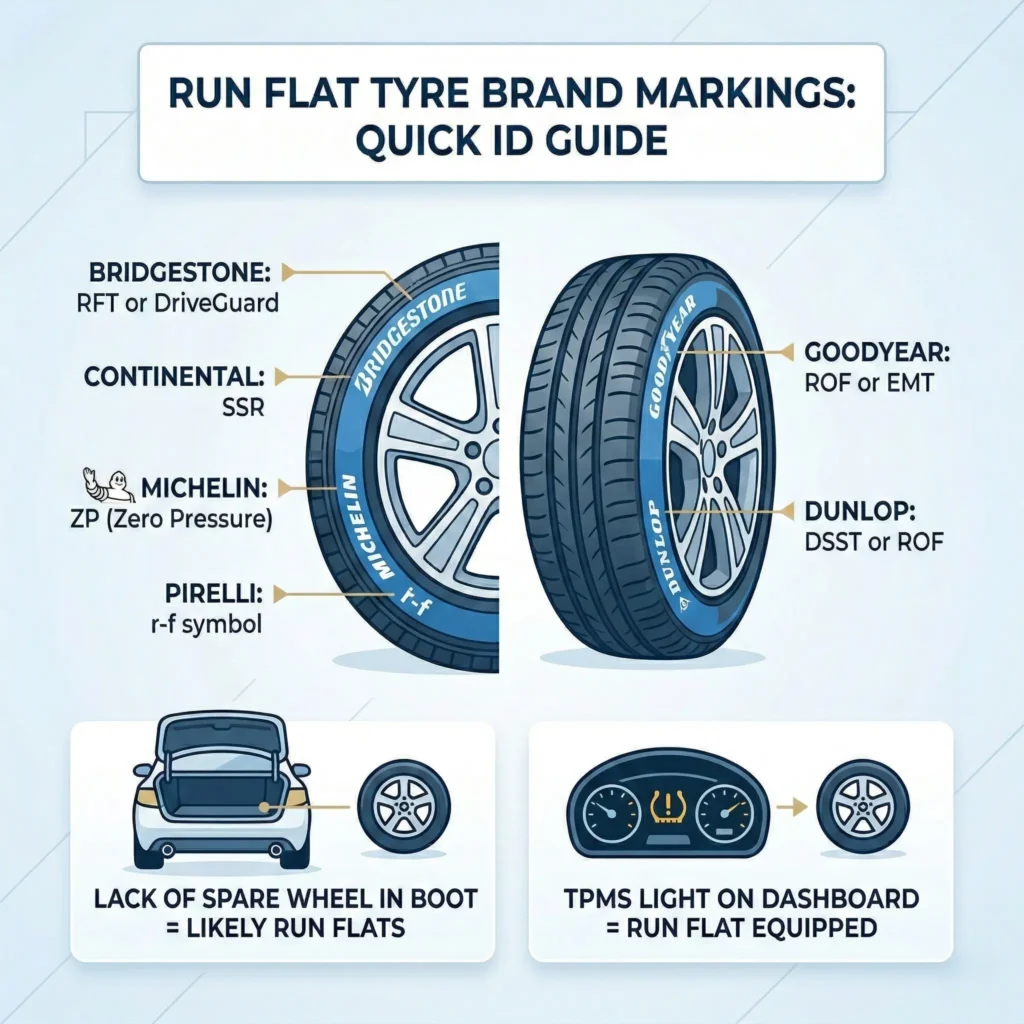
Check your tyre sidewall. Look for these markings:
| Brand | Run Flat Symbol | Full Name |
| Bridgestone | RFT / DriveGuard | Run Flat Tyre |
| Continental | SSR | Self-Supporting Runflat |
| Michelin | ZP | Zero Pressure |
| Pirelli | r-f | Run Flat |
| Goodyear | ROF / EMT | Run On Flat / Extended Mobility |
| Dunlop | DSST / ROF | Self-Supporting Technology |
| Hankook | HRS | Hankook Running System |
Not sure? Two other ways to check:
- Look in your boot. No spare tyre? You probably have run flats.
- Check your vehicle handbook. The tyre spec section will confirm it.
Still confused? A quick call to a mobile tyre fitting specialist can confirm what’s on your car.
How Long Can You Drive on Run Flat Tyres After a Puncture?
50 miles. 50mph maximum.
That’s the general rule. But it varies.
| Factor | Standard Limit | Notes |
| Maximum distance | 50 miles (80km) | ISO 16992 standard |
| Maximum speed | 50mph (80km/h) | Do NOT exceed this |
| Vehicle load | Affects distance | Heavy loads reduce safe distance |
| Road conditions | Affects distance | Potholes and rough roads reduce it |
| Tyre condition pre-puncture | Critical factor | Worn run flats perform worse |
Here’s what nobody tells you.
Those 50 miles assume perfect conditions. Good roads. Light load. Fresh tyre. Real-world driving in London? With potholes, speed bumps, and heavy traffic? You might get 30 miles safely.
Don’t push it. Get to safety and call for emergency tyre replacement. Driving further risks destroying the wheel rim. That’s a £200-£500 problem on top of the tyre cost.
Run Flat Tyres Pros and Cons: The Honest Breakdown
Everyone wants a simple answer. Worth it or not?
It’s not that simple. Here’s the real picture.
The Genuine Advantages
Safety after puncture:
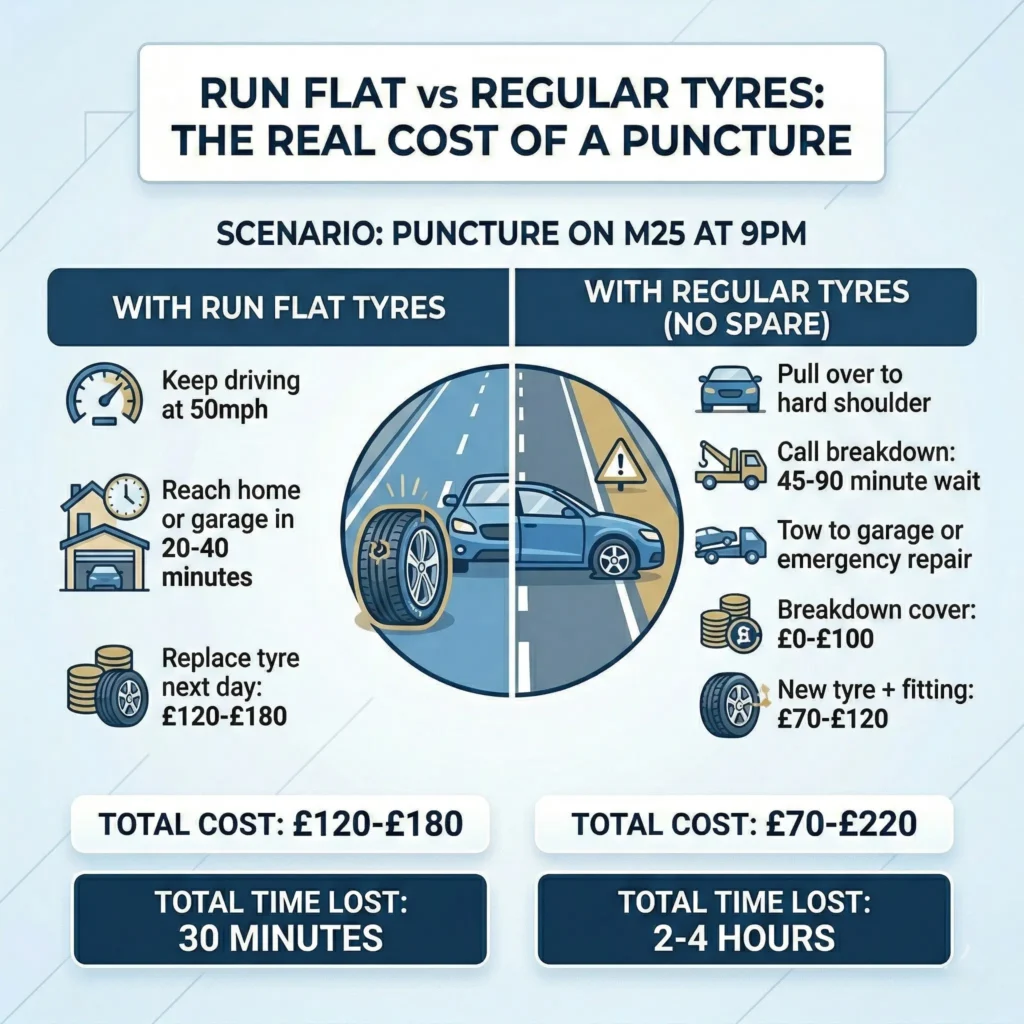
You keep driving. No panic. No pulling over on a dark motorway hard shoulder. In the UK, standing on a motorway hard shoulder is one of the most dangerous things you can do as a driver. Run flats eliminate that risk.
No spare tyre needed:
Saves 15-25kg of weight. Frees boot space. Every car manufacturer loves this because it improves fuel economy and gives you more room.
Peace of mind:
Night driving. Remote areas. Bad weather. You won’t be stranded. That matters.
The Real Downsides
Higher cost:
Run flat tyres cost 20-25% more than standard equivalents. A premium run flat in 225/45R17 costs £120-£180 per tyre. Standard equivalent? £90-£140.
Harsher ride quality:
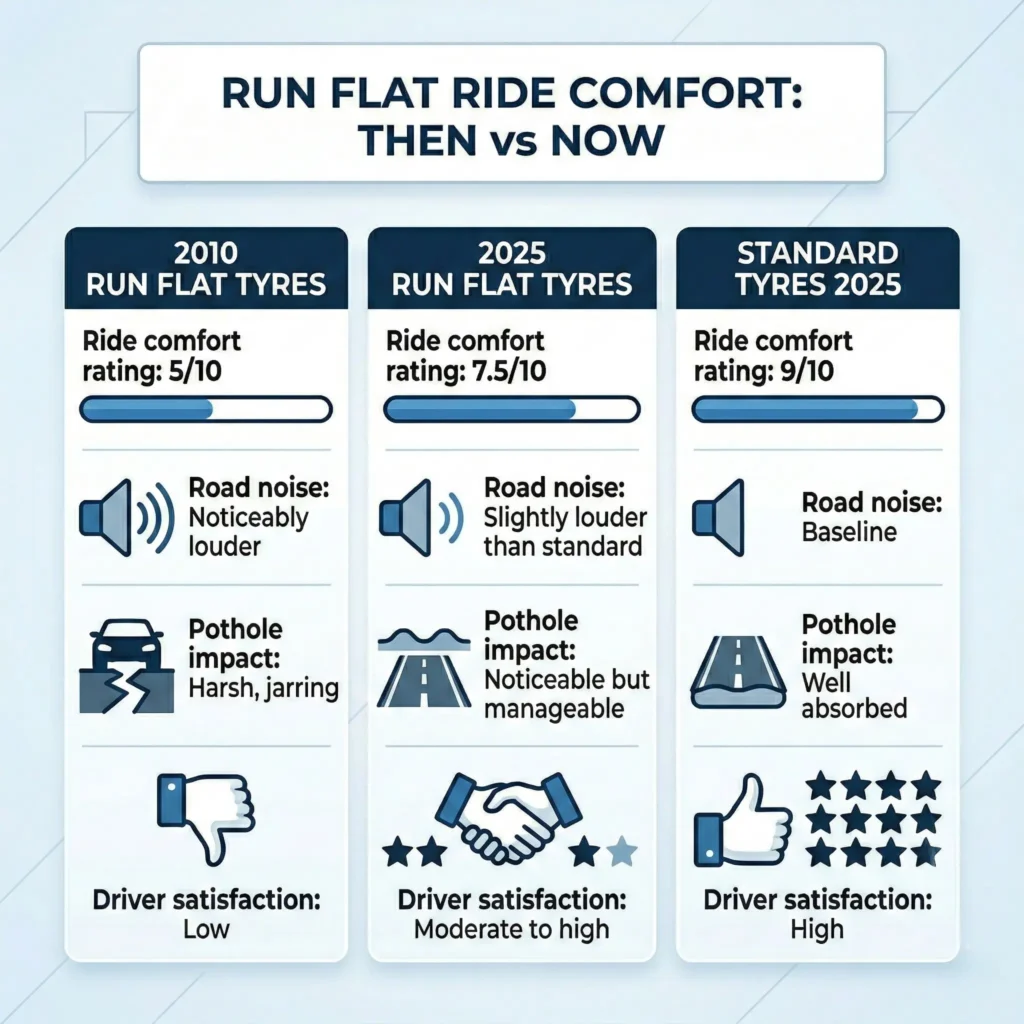
Those reinforced sidewalls are stiff. Really stiff. You’ll feel more bumps. More road noise. London’s pothole-filled roads make this worse. Modern run flats have improved massively, but they’re still firmer than standard tyres.
Can’t be repaired (usually):
Once a run flat goes flat, it’s done. Most tyre fitters won’t repair them. The internal structure gets compromised when driven on without air. Full replacement every time.
Limited availability:
Not every size exists in run flat. Not every garage stocks them. You might wait days for the right tyre.
| Factor | Run Flat Tyres | Regular Tyres |
| Price per tyre (205/55R16) | £100-£160 | £70-£120 |
| Ride comfort | Firmer, stiffer | Softer, smoother |
| After puncture | Drive 50 miles at 50mph | Stranded (unless spare) |
| Repairability | Rarely repairable | Usually repairable (£15-£30) |
| Spare tyre needed | No | Yes (or repair kit) |
| Road noise | Slightly louder | Quieter |
| Availability | Limited sizes | Widely available |
| Tyre lifespan | 25,000-50,000 miles | 25,000-50,000 miles |
Can Run Flat Tyres Be Repaired? The Honest Answer
Short answer? Usually not.
Long answer? It depends on the damage.
Why Most Run Flat Repairs Aren’t Possible
When you drive on a deflated run flat, the internal structure takes damage. The reinforced sidewalls flex and compress under the car’s weight. Even 10 miles of driving causes invisible structural damage that no fitter can assess from the outside.
Most garages and puncture repair services won’t touch a run flat that’s been driven on while flat. The liability risk is too high.
The Exception: Caught Early
If your TPMS catches a slow puncture early, and you haven’t driven on it while fully flat, a small tread puncture (nail, screw) might be repairable. Some manufacturers allow it if:
- Damage is in the tread area only (not sidewall)
- Puncture is smaller than 6mm
- Tyre wasn’t driven on at zero pressure
- Tyre has adequate remaining tread depth
But most fitters still won’t do it. And honestly? For safety, replacement is the right call.
Can You Replace Run Flat Tyres With Normal Tyres?
Yes. You can.
But there are things you must know first.
What Changes When You Switch
| Factor | Keep Run Flats | Switch to Regular |
| Puncture protection | Drive 50 miles | Stranded (need spare/kit) |
| Ride comfort | Firmer | Smoother, quieter |
| Cost per tyre | £100-£180 | £70-£130 |
| Spare tyre needed | No | Yes (buy one) |
| Repair options | Replace only | Repair possible (£15-£30) |
| Boot space | Full boot space | Less (spare takes room) |
The Rules for Switching
- Never mix run flats and standard tyres on the same car. Illegal in the UK and dangerous.
- You’ll need a puncture repair kit or space-saver spare.
- Some manufacturers void warranty if you switch. Check first.
- Your suspension was tuned for run flat stiffness. Regular tyres might feel floaty initially.
- TPMS still works fine with regular tyres.
Need help making the switch? A mobile tyre fitting service in London can fit standard tyres at your home. No garage visit needed.
Run Flat Tyres Cost: What You’ll Actually Pay in the UK
Price varies. A lot.
Here’s what real UK pricing looks like in 2025:
| Tyre Size | Budget Run Flat | Mid-Range Run Flat | Premium Run Flat |
| 195/55R16 | £70-£90 | £90-£120 | £120-£160 |
| 205/55R16 | £80-£100 | £100-£135 | £135-£170 |
| 225/45R17 | £90-£115 | £115-£155 | £155-£200 |
| 225/40R18 | £100-£130 | £130-£175 | £175-£230 |
| 255/35R19 | £120-£160 | £160-£210 | £210-£280 |
Prices include fitting at most retailers.
Premium Brand Pricing
Top brands like Bridgestone, Michelin, and Continental sit at the premium end. Worth it? For wet grip and longevity, usually yes.
Budget brands save 30-40% upfront. But they wear faster and grip worse in rain. London’s wet roads demand good wet grip. Don’t cheap out on safety.
Do Run Flat Tyres Ride Harsher? What London Drivers Say
Yes. They do.
That’s the honest answer. But context matters.
Why the Ride Feels Different
Those reinforced sidewalls that save you during a puncture? They’re stiffer than regular tyre walls. Stiffer sidewalls mean less flex over bumps. Less absorption. More vibration transferred into the cabin.
On smooth motorways? The difference is minimal. On London’s roads with potholes, speed bumps, and patchy tarmac? You’ll notice it. Every bump. Every imperfection.
Modern Run Flats Have Improved
The early run flats were awful. Genuinely uncomfortable. But manufacturers have invested heavily in improving ride quality.
Bridgestone’s DriveGuard range and Continental’s SSR technology are significantly softer than run flats from 10 years ago. Still firmer than regular tyres, but the gap is shrinking every year.
Run Flat Tyres vs Regular Tyres UK: Making Your Decision
So which should you choose?
Depends on your situation. Completely.
Choose Run Flats If:
- You do lots of motorway driving (safety benefit is highest)
- You drive at night or in remote areas regularly
- Your car came with them from the factory
- You don’t want to carry a spare tyre
- You value safety over ride comfort
Choose Regular Tyres If:
- Ride comfort is your top priority
- You want lower tyre costs long-term
- You mainly drive in urban areas with quick access to help
- You’re happy carrying a spare or repair kit
- You want tyres that can be repaired after a puncture
For London drivers, regular tyres with all-season performance often make more sense. Quick access to mobile tyre services across London means you’re never far from help.
Frequently Asked Questions About Run Flat Tyres
Q: Are run flat tyres worth it for city driving in London?
For pure city driving? Probably not. You’re never more than a few miles from help. A mobile wheel balancing and tyre service can reach you in 25-50 minutes anywhere in London. The extra cost and harsher ride may not justify the convenience.
Q: Can I put run flat tyres on any car?
Your car must have a working TPMS. Without it, you won’t know when a run flat has lost pressure. Most cars from 2014 onwards have TPMS fitted as standard (EU regulation). Check your handbook.
Q: How long do run flat tyres last compared to normal tyres?
About the same. Both last 25,000-50,000 miles depending on driving style, road conditions, and brand quality. Run flats don’t wear faster in normal use.
Q: Can I drive on a run flat tyre with a nail in it?
If the tyre still has pressure, yes. Drive carefully to a fitting centre. If pressure is lost, follow the 50 mile/50mph rule. Don’t ignore it. Read our guide on driving with a punctured tyre for more detail.
Q: Do all BMW models have run flat tyres?
Most do. BMW pioneered run flat technology as standard equipment. The 1 Series, 3 Series, and 5 Series typically come with run flats. Some newer models give you the option to switch. Always check your specific model.
The Bottom Line on Run Flat Tyres
Run flat tyres aren’t for everyone. They cost more. They ride harsher. They can’t be repaired.
But they keep you safe when it matters most. No roadside tyre changes. No waiting in the dark for breakdown recovery.
For motorway drivers? Strong recommendation. For London city drivers? Regular tyres with a good mobile fitting service make more sense financially.
Whatever you choose, Tyretick can help. We fit run flats and regular tyres across London, 24/7. At your home. At your office. Wherever you are. Get in touch for fast mobile tyre fitting today.
Your tyres, your choice. We just make it easy.