
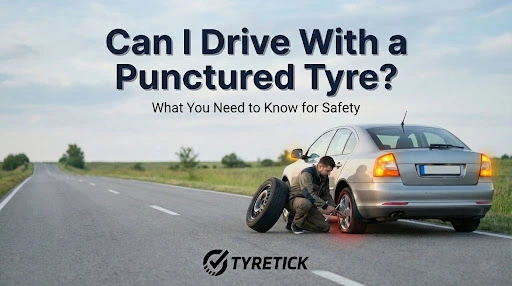
Many people on platforms like Reddit ask if they can drive with a punctured tyre. While it is strongly advised not to drive with a punctured tyre, there may be a few options to help you cover some distance.
However, how far you can safely go and what steps to take is key to staying safe on the road. This is what we will discuss in this detailed guide and help you travel safely.
Quick Answer: Should You Drive with a Punctured Tyre?
No, you should not drive normally on a tyre that has punctured and lost pressure. Driving with a flat or punctured tyre makes your car unroadworthy and unsafe. In most cases, it will also damage the tyre, wheel, and handling of the vehicle.
You might make a controlled move of a few metres or yards at very low speed, only to reach a safer stopping spot. But beyond that, continuing to drive is not advised.
What are the Dangers of Driving with a Punctured Tyre?
A flat tyre increases the risk of accidents and can even damage your rims. Apart from that, below are a few dangers of driving with a punctured tyre:
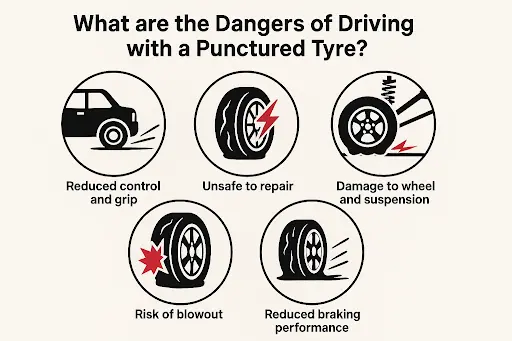
- It reduces control and grip, which increases the risk of skidding and loss of control.
- A punctured tyre damages the internal structure of the tyre, which makes it unsafe to repair.
- Flat tyres can wreck the wheel rim and suspension if driven on for too long.
- There is also a risk of a sudden blowout at speed with punctured tyres.
- A flat tyre also has a reduced contact patch with the road, which reduces brake performance and results in accidents.
Common Reasons for Driving with a Punctured Tyre
A flat tyre puts everyone’s safety at risk when the driver chooses to drive with it. Yet, the following reasons could be good justification to drive with a flat tyre:
- People may drive a short distance on a puncture just to get off a busy road in a remote area.
- Some drivers lack confidence or the tools to change a tyre on the roadside, so they take a short drive toward a safer spot.
- A slow puncture may not trigger a tyre pressure monitoring system immediately, so drivers feel the tyre is still usable.
- Misleading TPMS readings can occur if the monitoring system only alerts once a low threshold is reached, so drivers continue until they see the warning.
- A slow leak from a loose valve stem can cause tyre pressure to drop gradually, without anyone noticing until it’s too late.
What Immediate Steps Should I Take When I Find a Puncture?
Once you feel like your tyre is punctured, the first thing to do is to ensure your safety. Additionally, you must take the following immediate steps:
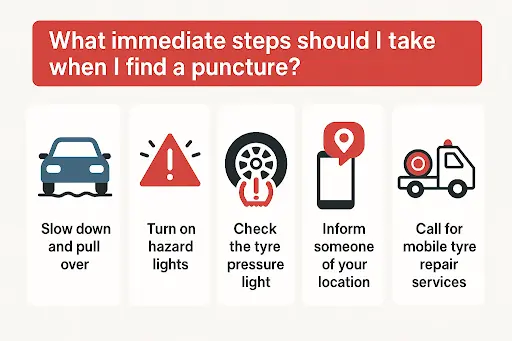
- Slow down and pull over safely to the safety lane with clear visibility.
- Turn on hazard lights and apply the parking brake to alert other drivers.
- Check the tyre pressure light and inspect the tyre for visible foreign objects.
- Take your phone out and inform someone of your location, especially if you’re on a dangerous road.
- If the tyre is completely flat and you can’t fix it on the spot, exit the road safely or call for mobile tyre repair services.
When Should You Replace a Punctured Tyre?
Repairs are only considered safe under British Standard BS AU 159 if the puncture is in the central tread area and the hole is small. If the damage is in the sidewall or larger than about 6 mm, the tyre usually needs replacing.
A tyre should also be replaced if it shows bulges, exposed cords, or any internal damage caused by driving on a flat tyre. That’s because these conditions mean the tyre cannot safely hold pressure.
How Far and How Fast Can I Drive on a Punctured or Flat Tyre?
You shouldn’t drive at a normal speed or for any distance with a standard flat tyre. If you must move the car, keep the distance very short and the speed very low. Vehicles fitted with run-flat tyres give you a different option.
These tyres have reinforced sidewalls that allow the car to remain stable even when they lose air pressure. Most manufacturers and UK tyre guidance advise that, after a puncture, you can drive up to about 50 miles and shouldn’t exceed about 50 mph to reach a garage.
How to Prevent Flat Tyres?
While you can rarely control small and sharp objects damaging your tyres on the road, there are still some precautionary measures to prevent flat tyres. A few measures you can take are:
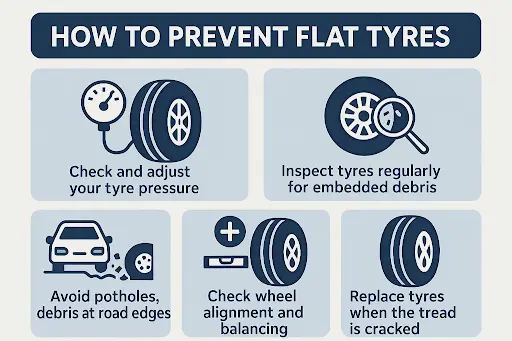
- Check and adjust your tyre pressure at least once a month, including the spare, to keep tyres firm and reduce overheating.
- Inspect tyres regularly for embedded glass or debris, and remove any visible items before driving longer distances.
- Avoid obvious hazards such as potholes, debris at road edges, and construction zones, as impacts are a common cause of tyre damage.
- Check wheel alignment and balancing during routine service, as uneven wear increases puncture risk.
- Replace tyres when the tread is cracked, since worn rubber cannot protect against sharp objects.
How Do I Decide Whether to Change the Tyre Myself or Call for Help?
If you have the required expertise and the tools, like a spare tyre, a jack, and a wrench, to change the tyre, you can do it yourself. If you’re unsure about the exact process, here’s a clear step-by-step guide on how to safely change a punctured tyre on the roadside so you don’t make any mistakes. You just need to ensure you are parked in a safe location away from ongoing traffic and have sufficient expertise with the tools.
However, you should call for help if any of the following apply:
- The puncture occurs on a busy main road where it’s unsafe to stop,
- You don’t have a usable spare, jack, or wheel brace.
- The wheel nuts are seized and won’t open.
- You lack the strength or confidence to do the job safely.
In these cases, it’s better to get professional help. For example, Tyre Tick Fast Tyre provides 24/7 mobile tyre fitting and repair in the UK. We send fully equipped technicians to your location, no matter where you are located. All you need to do is send your location, confirm your tyre type, and choose the tyre you need, and our team will be there.
Need Immediate Mobile Tyre Help?
Fast roadside rescue, expert fitting, and friendly support across the UK.
Conclusion
Driving on a punctured tyre is unsafe and is not recommended except for a very short distance. If you have run-flat tyres, you can travel up to about 50 miles at around 50 mph to reach help. Wherever possible, stop safely, assess the damage, and seek professional repair services if you are unable to do so yourself. If you’re preparing your vehicle for seasonal weather changes, understand whether it’s safe to use summer tyres in winter conditions and when you should switch to winter tyres for safer driving.
FAQs
1. Can I drive on a tyre with a nail in it?
If a nail has only lodged in the tread and the tyre still holds proper pressure, you may move a short distance, but get it repaired promptly.
2. Are tyre sealants safe to use?
Sealants may temporarily block small punctures and let you reach a garage, but they are a short-term fix. Ideally, the tyre should be professionally repaired or replaced.
3. Is it illegal to drive on a flat tyre?
Yes, driving with a flat tyre makes the vehicle unroadworthy under UK law, which could lead to a £100 fine and three penalty points on your license.
4. How long can you drive on a flat tyre without damaging the rim?
For a conventional tyre, only a few metres or yards at a very slow speed to reach a safe stopping place. However, a run-flat tyre allows travelling up to 50 miles without damaging the rim.
